

Categories
Finance & Accounting Outsourcing new blog

From Outstanding Invoices to Predictable Cash Flow: How U.S. Businesses Can Improve AR Without Expanding Their Finance Team

A business can be profitable on paper and still run out of cash, and slow accounts receivable is the most common reason why. The revenue is real. The invoice went out. The customer will almost certainly pay eventually. None of that helps when payroll is due Friday and the money everyone is counting on is still sitting in someone else’s accounts payable queue.

Intuit QuickBooks’ 2025 Small Business Late Payments Report found that 56 percent of US small businesses were owed money from unpaid invoices at the time of the survey, averaging $17,500 per business, and that businesses with longer payment delays were 1.4 times more likely to report cash flow problems than those without. That is not a niche issue affecting a handful of unlucky companies. It is closer to the default state of doing business in the US right now.

This guide covers what slow-paying customers actually cost, what a good DSO looks like by company size, what accounts receivable outsourcing includes, what it costs, and how to choose a provider that improves cash flow without adding headcount.

What Improving AR Actually Means

Accounts receivable outsourcing means handing invoicing, payment application, collections outreach, and dispute resolution to an external team, so overdue invoices get worked consistently instead of whenever someone internal finds the time between other responsibilities.


It is not the same as a collection agency, which typically only gets involved once an account is seriously delinquent and takes a large cut of whatever it recovers. AR outsourcing works the full receivables cycle from the first invoice, aiming to prevent accounts from reaching that point at all, which is a materially better outcome for both cash flow and the customer relationship.

What Slow-Paying Customers Actually Cost US Businesses

Quadient’s 2025 review of the AR landscape puts real numbers on a problem most finance teams feel but rarely quantify. Roughly 44 percent of B2B invoices in the US are overdue at any given time, with about 3 percent eventually written off as bad debt entirely. The average cash conversion cycle across more than 2,700 US public companies sat at 89 days in early 2025, and US companies collectively carry an estimated $1.7 trillion in excess working capital tied up in receivables that could otherwise fund payroll, inventory, or growth instead of sitting on someone else’s books.


The QuickBooks data adds the small business view of the same problem: 47 percent of small businesses reported invoices overdue by more than 30 days, and roughly 1 in 10 invoices fall into that overdue category on average. Affected businesses were also 1.4 times more likely to have recently raised prices, by an average of 16 percent, simply to protect margin against cash they were not collecting on time.

Why DSO Creeps Up Even When the Team Is Working Hard

Days Sales Outstanding rarely spikes overnight. It drifts, a few days at a time, usually for reasons that have nothing to do with effort. Collections often sits as a part-time responsibility bolted onto someone’s actual job, so it gets attention only after invoicing, month-end close, and everything else more urgent is handled. Follow-up tends to happen inconsistently, a phone call one month and nothing the next, which customers notice and, fairly or not, treat as a signal about how strictly the business enforces its own payment terms.


There is also a structural ceiling on how far internal effort alone can close the gap. Quadient’s research found that 72 percent of finance leaders now use AI tools in some part of their workflow, up sharply from 34 percent previously, and that more than 60 percent of CFOs plan to increase automation investment in 2025 with AR specifically named as a priority. Businesses without that infrastructure are not just working harder than necessary. They are working against a growing gap between what modern AR operations can do and what a single internal hire, however capable, can keep up with manually.

DSO Benchmarks: What Good Actually Looks Like

What counts as an acceptable DSO depends heavily on company size and industry, and comparing a small business to an enterprise benchmark is a common way finance teams either panic unnecessarily or miss a real problem.

Company size Target DSO What typically drives it
Under $50 million revenue 15 to 30 days Cash flow is closer to a survival issue than an optimization exercise
$50 million to $500 million 30 to 45 days Portfolio growth outpacing internal collections capacity
$500 million and above 45 to 60+ days Multi-entity billing, longer negotiated terms, customer portals

Source: DSO benchmark analysis by company size, 2026.

A small business sitting at 40 to 45 days or higher is not simply behind schedule. It is typically a sign that collections needs real, dedicated attention rather than another quarter of hoping the backlog clears itself.

In-House AR Team vs. Outsourced AR: The Real Numbers

Robert Half’s 2026 Salary Guide puts the national range for an Accounts Receivable Clerk at $44,000 to $58,000, and a Credit and Collections Specialist, the role usually needed once collections becomes a real workload rather than an afterthought, at $48,000 to $68,750. Add benefits, payroll tax, and management time, and one dedicated in-house AR hire commonly runs well past $60,000 to $80,000 a year fully loaded.


Outsourced AR pricing tends to scale with portfolio size and complexity rather than following a flat rate. Industry pricing data puts typical monthly fees between roughly $500 for a small portfolio of accounts and $7,000 or more for a larger, more complex customer base, generally landing 30 to 40 percent below the cost of an equivalent in-house salaried hire.

Option Typical cost Best fit
In-house AR clerk (fully loaded) $60,000–$80,000+/year High-volume AR with dedicated headcount to spare
Outsourced AR, small portfolio ~$500 to $2,000/month Businesses with a smaller, lower-complexity customer base
Outsourced AR, larger portfolio $3,000 to $7,000+/month Growing companies with rising invoice and customer volume

Sources: Robert Half 2026 Salary Guide; industry pricing data compiled from US-based AR outsourcing providers, 2026.

What Should Be Included in an AR Outsourcing Engagement

A provider that only sends automated payment reminders is not really managing AR. A properly scoped engagement should include invoice generation and delivery, payment application and reconciliation, structured collections outreach with defined escalation stages, dispute and deduction handling, and monthly AR aging reports that give a finance leader a real read on where cash actually stands.


It should also protect the customer relationship deliberately, not as an afterthought. Escalation should follow a tone and sequence the business actually approves of, not a generic script, since the goal is faster payment without a damaged account. Businesses that need the full picture can pair AR outsourcing with finance and accounts outsourcing for the broader books, and FP&A services to turn a cleaner AR ledger into an actual cash flow forecast rather than a static report.

How to Choose an AR Outsourcing Partner

Ask exactly how collections outreach is scripted and escalated, and ask to see a real example rather than a description of the process. Ask how disputes and short payments are handled, since this is where a weak provider quietly lets cash slip through. Ask what reporting looks like month to month, and whether DSO and aging trends are tracked as a standing metric or produced only on request. Ask how customer relationships are protected during escalation, since a provider optimizing purely for speed can cost more in churned accounts than it saves in days of DSO.


  • A named team handling the account, not a rotating pool of contractors
  • A clearly defined, business-approved escalation process for overdue accounts
  • Real-time or near real-time reporting on DSO and aging, not month-end only
  • Dispute and deduction handling included, not billed as a separate service
  • A realistic onboarding timeline, ideally under two weeks
  • References from businesses of a similar size and customer volume

Why US Companies Choose Unison Direct

Unison Direct runs accounts receivable as part of its finance and accounts outsourcing services for US businesses across SaaS, ecommerce, healthcare, real estate, and professional services, with a named team handling each account rather than a rotating pool of contractors.


Onboarding typically takes 3 to 5 business days, not weeks. The team works onshore for client and customer contact, with offshore delivery capacity behind it, which keeps cost down without losing the tone and judgment a customer-facing collections process needs. Data security runs on encrypted infrastructure with SOC 2, ISO-aligned, GDPR, and HIPAA-aware practices already in place.


Businesses that want AR handled alongside the rest of finance can also draw on Unison Direct’s Virtual CFO ServiceFP&A, and business advisory services, all built to work off the same clean numbers rather than in a separate silo.

The Bottom Line

Cash flow problems rarely start with a lack of revenue. They start with revenue that has not been collected yet, sitting in an AR ledger nobody has had the bandwidth to work consistently. With 44 percent of B2B invoices overdue nationally and small businesses averaging $17,500 in unpaid invoices apiece, the honest question is not whether AR needs attention. It is whether that attention comes from a dedicated outsourced team or from a finance leader’s own evenings and weekends.


Price it out before assuming the current setup is fine. For most businesses collecting from more than a handful of recurring customers, outsourced AR costs less than one in-house hire and turns DSO into a number that gets managed on purpose, not one that gets discovered at month-end.


Book a free consultation with Unison Direct to see what a properly scoped AR outsourcing engagement would look like for your business, and how quickly it could start.

Frequently Asked Questions

Accounts receivable outsourcing is hiring an external team to manage invoicing, payment application, collections outreach, and dispute resolution, so a business gets paid faster without adding in-house AR headcount.

Businesses under roughly $50 million in revenue should generally target Days Sales Outstanding of 15 to 30 days. A DSO above 40 to 45 days is usually a sign that collections need attention rather than a normal cost of doing business.

Outsourced AR services typically run from around $500 a month for a small portfolio of accounts up to $7,000 or more a month for a larger, more complex customer base, generally 30 to 40 percent less than the cost of an equivalent in-house salaried employee.

Intuit QuickBooks’ 2025 Small Business Late Payments Report found 56 percent of US small businesses were owed money from unpaid invoices, averaging $17,500 per business, and businesses with longer delays were 1.4 times more likely to experience cash flow problems.

Done well, it should not. A properly run AR outsourcing provider follows the same tone and escalation rules the business would use internally, and many customers do not notice a difference beyond faster, more consistent follow-up on overdue invoices.

A well-run provider can typically begin working an existing AR ledger within one to two weeks of receiving customer and invoice data. Unison Direct’s finance and accounts outsourcing team typically onboards clients within 3 to 5 business days.

Categories
Finance & Accounting Outsourcing new blog

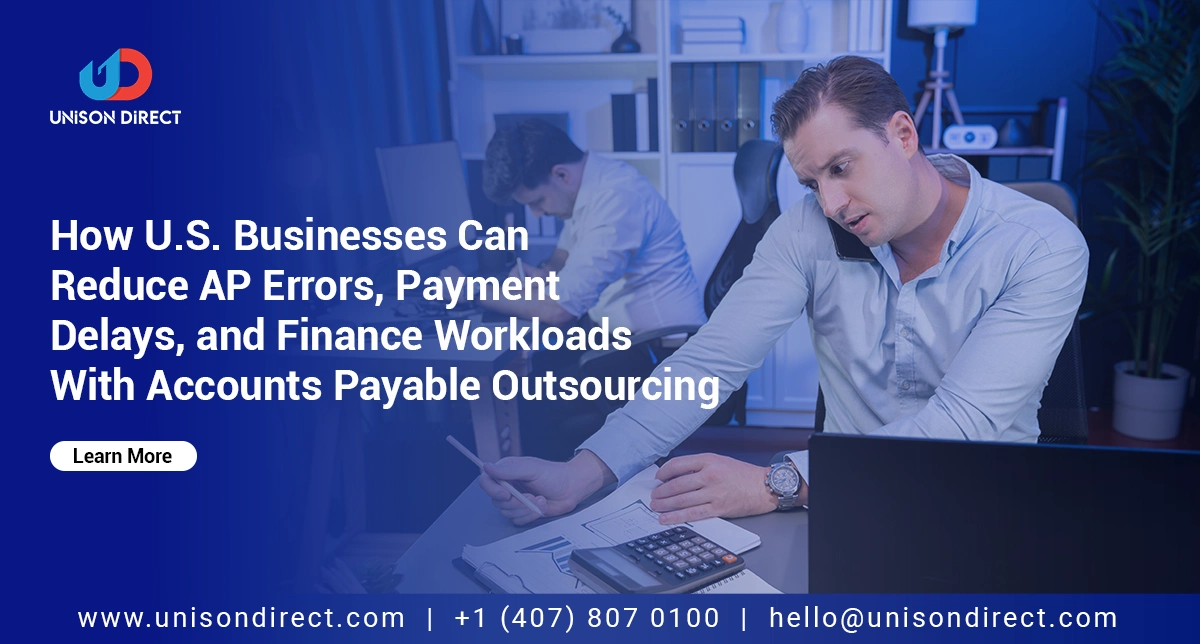
How U.S. Businesses Can Reduce AP Errors, Payment Delays, and Finance Workloads With Accounts Payable Outsourcing

Somewhere in most finance teams, a stack of invoices is sitting half processed, waiting on someone to check a PO number, chase an approver, or figure out why the same bill showed up twice. None of it is complicated work. All of it eats hours every week, and every hour spent matching line items is an hour not spent on anything that actually grows the business.

Ardent Partners’ 2025 research on AP performance puts a number on that drag. The average invoice takes 9.2 days to process and costs $9.40, while the best-run AP teams do it in 3.1 days for $2.78. That gap, roughly three times the cost and three times the time, is not a technology problem so much as a resourcing and process problem. It is also exactly the gap accounts payable outsourcing is built to close.

This guide covers what manual AP is actually costing US businesses, what a properly scoped outsourcing engagement includes, what it costs, and how to pick a provider that earns the fee rather than just moving the paperwork somewhere else.

What Accounts Payable Outsourcing Actually Means

Accounts payable outsourcing means handing the end-to-end AP process, invoice receipt and capture, three-way matching against purchase orders and receipts, coding, approval routing, payment execution, and vendor query handling, to an external team instead of running it with in-house staff.


It is worth separating this from AP automation software. A tool that scans and codes invoices still needs someone reviewing exceptions, chasing approvals, and running payment batches. Outsourcing includes the software layer but pairs it with a team that actually owns the outcome, so the business gets processed, approved, paid invoices, not just a faster queue of invoices still waiting on someone internal.


For most US companies, that means outsourcing sits alongside finance and accounts outsourcing more broadly, since AP rarely runs in isolation from the rest of the books.

What Manual AP Actually Costs US Businesses

The per-invoice numbers matter, but they understate the real drag. Industry benchmarks vary by methodology, DocuClipper’s 2026 review of AP research puts the fully loaded cost of manual processing, including labor, error correction, and late fees, as high as $12 to $30 per invoice, while roughly 39 percent of invoices contain some kind of error on first submission.


Time is the other side of it. Ardent Partners found that underperforming AP functions take an average of 17.4 days to process a single invoice end to end, nearly six times longer than best-in-class teams at 3.1 days. Multiply that by a few hundred invoices a month and the gap stops looking like a rounding error and starts looking like a full-time job that exists only to compensate for a slow process.


Metric Industry average Best-in-class
Cost per invoice $9.40 $2.78
Processing time 9.2 days 3.1 days
Invoice exception rate 22% 9%

Source: Ardent Partners, 2025 Accounts Payable Metrics That Matter report.

The gap between average and best-in-class is not explained by company size or industry. It is explained by process discipline, clean supplier data, and enough dedicated capacity to catch problems before they become late payments. That is precisely what a scoped outsourcing engagement is built to deliver.

The Hidden Risks: Fraud, Duplicate Payments, and Missed Discounts

Slow, manual AP is not just inefficient. It is a security gap. The 2026 AFP Payments Fraud and Control Survey found that checks remain the payment method most targeted by fraud, reported by 58 percent of organizations, ahead of ACH debits at 30 percent and wire transfers at 25 percent. Businesses still cutting paper checks and approving payments over email are carrying meaningfully more fraud exposure than they may realize.


Duplicate payments and missed early-payment discounts round out the hidden cost. A vendor invoice paid twice because two people processed it independently, or a 2/10 net 30 discount missed because the invoice sat in someone’s inbox for two weeks, rarely shows up as a single dramatic loss. It shows up as a slow, compounding leak that most finance teams never fully quantify because nobody is tracking it as a line item.

In-House AP Team vs. Outsourced AP: The Real Numbers

An in-house AP clerk in the US carries a national salary range of $43,250 to $54,750 according to Robert Half’s 2026 Salary Guide, before benefits, payroll tax, software licenses, and management time are added. That typically pushes the fully loaded cost of one AP hire to $50,000 to $80,000 a year.

Option Typical cost Best fit
In-house AP clerk (fully loaded) $50,000–$80,000/year High-volume AP with dedicated headcount to spare
Outsourced AP, small business $1,000–$3,000/month Businesses with lower or seasonal invoice volume
Outsourced AP, mid-size company $5,000–$10,000+/month Growing companies with rising invoice volume and multiple approvers

Sources: Robert Half 2026 Salary Guide; industry pricing data compiled from US-based AP outsourcing providers, 2026.

Reported savings from moving to outsourced AP commonly fall in the 30 to 60 percent range compared with an equivalent in-house hire, largely because the business pays for the work actually done rather than a full salary, benefits package, and the software license sitting behind it.

Signs It Is Time to Outsource Accounts Payable

  • Invoices routinely take more than a week to move from receipt to payment, and nobody can say exactly why.
  • The same person who processes invoices also approves them, which is a control gap most auditors will flag.
  • Vendors are calling to ask where their payment is, rather than the business catching the delay first.
  • Early-payment discounts are known to exist but are rarely captured because nobody is tracking the deadline.
  • Invoice volume is growing faster than the finance team, and hiring another clerk feels like treating a symptom rather than the cause.
  • Payments still go out by paper check as a default, not an exception.


If two or more of these sound familiar, the cost of staying manual is very likely higher than the cost of outsourcing it, even before factoring in the time a finance leader spends managing the backlog personally.

What Should Be Included in an AP Outsourcing Engagement

A provider that only re-types invoices into accounting software faster is not actually fixing AP. A properly scoped engagement should include invoice capture and data extraction, three-way matching against purchase orders and receiving records, GL coding, approval workflow management, payment execution across ACH, wire, and card, vendor query and dispute handling, and month-end AP reporting that ties out cleanly.


It should also include exception handling as a standard part of the service, not an add-on, since exceptions are exactly where manual AP loses the most time. Businesses that need more than AP alone can typically add finance and accounts outsourcing for the broader books, FP&A services for cash flow forecasting that actually uses clean AP data, and payroll outsourcing where payroll and vendor payments run through the same finance function.

How to Choose an AP Outsourcing Partner

Cost matters, but it should not be the first filter. Ask who specifically will be working on the account, not just who is selling the engagement. Ask how they handle three-way matching and exceptions today, with a real example rather than a description. Ask what payment methods they support and how they are moving clients off paper checks, given how disproportionately checks are targeted by fraud. Ask about data security certifications directly, and ask how fast they can realistically onboard.


  • A named team handling the account, not a rotating pool of contractors
  • Clear separation between who processes and who approves payments
  • Support for ACH, wire, and card payments, not just checks
  • Security practices such as SOC 2 or ISO-aligned controls, confirmed in writing
  • A realistic onboarding timeline, ideally under two weeks
  • References from businesses of a similar size and invoice volume

Why US Companies Choose Unison Direct

Unison Direct runs accounts payable as part of its finance and accounts outsourcing services for US businesses across SaaS, ecommerce, healthcare, real estate, and professional services, with a named team handling each account rather than a rotating pool of contractors.


Onboarding typically takes 3 to 5 business days, not weeks. The team works onshore for client contact and control, with offshore delivery capacity behind it, which keeps cost down without loosening approval controls or US compliance standards. Engagement models stay flexible, whether monthly retainer or per-invoice, depending on actual volume rather than a fixed package. Data security runs on encrypted infrastructure with SOC 2, ISO-aligned, GDPR, and HIPAA-aware practices already in place.


Businesses that want AP handled alongside the rest of finance can also draw on Unison Direct’s Virtual CFO Service, FP&A, and business advisory services, all built to work off the same clean numbers rather than in a separate silo.

The Bottom Line

Manual AP rarely fails all at once. It fails a little at a time, in a missed discount here, a duplicate payment there, a vendor call that did not need to happen. Ardent Partners’ numbers show the gap between average and best-in-class AP is roughly three times the cost and three times the time, and that gap is almost entirely closeable through process and dedicated capacity, not a bigger internal team.


Price it out before assuming the current setup is fine. For most businesses processing more than a couple hundred invoices a month, outsourced AP costs less than one in-house hire and closes the process gap that hire alone would not fix.


Book a free consultation with Unison Direct to see what a properly scoped AP outsourcing engagement would look like for your business, and how quickly it could start.

Frequently Asked Questions

Accounts payable outsourcing is hiring an external team to manage the full AP process, including invoice capture, three-way matching, coding, approval routing, payment execution, and vendor queries, rather than handling it with in-house staff.

Ardent Partners’ 2025 research puts the industry average cost to process one invoice at $9.40, against $2.78 for best-in-class AP teams. Other benchmarks that include labor, error correction, and late fees put the fully loaded cost as high as $12 to $30 per invoice.

Outsourced AP services typically run $1,000 to $3,000 a month for small businesses and $5,000 to $10,000 or more a month for mid-sized companies, or $2 to $10 per invoice depending on volume and complexity. That compares with $50,000 to $80,000 a year for one in-house AP clerk before benefits.

Ardent Partners’ 2025 benchmarks put the industry average invoice exception rate at 22 percent, meaning roughly one in five invoices needs manual intervention. Best-in-class AP teams hold that rate closer to 9 percent through automation and clean supplier data.

A properly run outsourced AP provider should reduce risk rather than add to it, using segregated approval workflows, encrypted infrastructure, and SOC 2 or ISO-aligned controls. Businesses should confirm these practices in writing before signing, rather than assuming they are in place.

A well-run provider can typically onboard a new client within one to two weeks once vendor lists, approval hierarchies, and payment terms are shared. Unison Direct’s finance and accounts outsourcing team typically onboards clients within 3 to 5 business days.

Categories
Finance & Accounting Outsourcing new blog

F&A Pay Raises Just Doubled. The Talent Pool Didn’t.

Ask a CFO what they did about the accounting talent shortage this year and most will say the same thing. They raised pay. According to the Controllers Council’s 2026 Corporate Finance and Accounting Talent Study, North American companies increased salaries for finance roles by an average of 6% over the past twelve months, and the study’s authors describe that jump as nearly double the salary growth reported a year earlier. That is the biggest lever in the CFO’s toolkit, pulled about as hard as it goes.


It did not work the way anyone hoped. The same study found a Talent Shortage Index of 77% in 2026, a sharp reversal from a Talent Surplus Index of 108% in 2025. The market flipped from too many candidates to too few in a single year, while employers were simultaneously paying more than they had in years to close the gap. Sixty one percent of finance leaders now report shortages, up from 46% the year before, and controllers top the list of hardest roles to fill, cited by 44% of respondents.


Executives got the largest raises at 6.7%, directors 6.2%, managers 5.9%, and clerical and administrative staff 5.7%, according to the same research. Almost nobody in the finance function was spared the raise. Almost nobody in the finance function got easier to hire because of it.

The raise that did not buy what it used to

Here is the part that should worry anyone budgeting for 2027. Robert Half’s own 2026 Salary Guide tells a quieter, almost contradictory story. Its benchmark salary growth for finance and accounting roles has been slowing for three straight years, from 4.0% in 2023 to 3.1% in 2024, up slightly to 3.6% in 2025, then down to a projected 2.1% for 2026. Read the two studies side by side and the picture gets stranger. The guide rate employers are supposed to budget against is falling. The raises they are actually handing out to keep people are accelerating. That gap between plan and reality is usually where a labor market turns structural instead of cyclical.

Robert Half’s own data backs that up. Eighty five percent of finance leaders in its survey said they are working to retain top talent, 80% say they need to hire skilled candidates faster than they currently can, and 76% report critical skills gaps on their teams. Specific roles are pulling far ahead of that flat 2.1% average too. Senior tax services associates are projected to see 5.8% growth this year, audit and assurance managers 3.7%, treasury analyst managers 3.6%. Pay is not flat everywhere. It is flat on average and steep wherever the shortage actually bites.

Base salary is also not the full cost of a domestic hire, which is part of why the arithmetic tilts further than the headline numbers suggest. Robert Half’s own guidance to employers this year is to think in terms of total compensation rather than salary alone, once bonuses, retirement matching, hybrid work stipends and benefits are added in. A finance role quoted at 70,000 dollars in base pay routinely costs an employer meaningfully more once those additions are counted, and that fully loaded figure is the one that actually competes against an outsourced hourly rate, not the headline salary number.
Some industries feel all of this harder than others. Robert Half’s research points to financial services, healthcare, manufacturing and nonprofit organizations as the sectors paying the steepest premiums for finance talent right now, driven by compliance and reporting demands specific to each. A healthcare system managing patient billing and cost reporting, or a manufacturer rebuilding supply chain and cost controls, is not competing for a generalist accountant. It is competing for someone who already understands its sector, which shrinks an already small pool even further.

Why the pipeline stopped refilling

The shortage did not appear out of nowhere, and it will not fix itself once hiring normalizes, because normal is not what broke it. More than 300,000 accountants and auditors left the US workforce between 2019 and 2022, a drop of roughly 17% in the profession, and the people replacing them were never going to arrive at the same rate. The number of candidates sitting the CPA exam has fallen more than 30% since 2016. CPA candidates overall are down 27% over the past decade. The Bureau of Labor Statistics projects more than 120,000 accounting and auditing openings a year against roughly 55,000 new accounting graduates.
That whiplash from a talent surplus to a talent shortage in twelve months traces back to hiring decisions made years earlier, not to anything that happened this year specifically. Plenty of companies pulled back on finance and accounting hiring in 2023 and 2024 while they waited out inflation and higher rates, which is a large part of why last year’s survey still showed a surplus. The open roles did not disappear. The demand came back in 2026 as budgets loosened, but the people who would have been five years into an accounting career by now, instead of just entering one, mostly are not there. A hiring freeze does not pause a profession’s pipeline. It just moves the shortage a few years down the road and hands it to whoever is CFO when hiring resumes.
Put another way, for every two people the profession needs to replace, one shows up. That is not a cyclical dip that resolves when the economy cools or a recession thins out demand. Most analysts studying the shortage describe it as structural, tied to retirements and a shrinking pipeline rather than a temporary mismatch between supply and demand, and several forecasts expect the gap to persist into the early 2030s.
Raising salaries assumes the problem is that people are choosing other jobs over accounting because the pay is better elsewhere. Some of that is true. But the Controllers Council study found the leading reason finance employees actually leave their employer is a lack of career advancement opportunities, cited by 54% of respondents, up from 43% the year before. Inadequate compensation ranked second, at 29%. Pay is a real factor here. It is not the leading one, which is part of why raising it has not refilled the pipeline.

The quiet fix companies are actually making

What is changing is not who companies are trying to hire. It is where. A growing number of US finance leaders are building dedicated offshore F&A teams instead of continuing to bid up domestic salaries against a shrinking pool, and the leading destination for that work is India, for reasons that are mostly arithmetic rather than fashion.
The median US accountant earns close to 81,680 dollars a year before benefits, according to industry salary data, working out to roughly 39 dollars an hour. Outsourced F&A delivery from India typically runs 8 to 12 dollars an hour for bookkeeping work and 15 to 25 dollars an hour for more specialized functions like tax preparation and financial reporting. A US-based role that costs a company something like 70,000 dollars a year once benefits and payroll taxes are added in can run closer to 12,000 to 15,000 dollars a year delivered from India. Estimates across the outsourcing industry generally put the savings at 40% to 70% versus an equivalent US hire, and that range holds up whether the work is bookkeeping, accounts payable, reconciliations or full cycle accounting.
Cost is the number that gets quoted in board meetings, but capacity is the reason the arrangement holds up over time rather than becoming its own bottleneck. India’s professional services sector supports close to 1.9 million people working inside global capability centers, sitting inside a broader IT and business process sector valued at more than 315 billion dollars. That is not a pool a single US employer competes against 55,000 domestic graduates for. It is a pipeline built specifically around finance, accounting and reporting work at scale, producing candidates trained in US GAAP, IFRS and the ERP platforms American finance teams already run.

The skills employers are paying the most to secure right now, financial reporting, data analytics, financial modeling and ERP expertise according to Robert Half’s own survey of finance leaders, are also the skills a mature outsourced delivery team gets built around from the start, rather than assembled one expensive hire at a time. Instead of recruiting a single specialist and hoping they stay through the next raise cycle, companies working with an established finance and accounts outsourcing services provider get a team structured around those functions from day one.

This is not a stopgap measure companies are using to survive a tight year. It is showing up as a structural change in how the finance function gets staffed, because the underlying shortage is structural too. A team built once and managed properly does not need to win a bidding war against every other US employer chasing the same 55,000 graduates a year.

Won't automation just fix this instead

It is a fair question, and the same Controllers Council study found significant AI adoption inside finance functions this year, alongside a shift back toward onsite work for the first time since the pandemic. But automation and offshore delivery are not competing answers to the same problem. They are being adopted together, because they solve different halves of it. Software is absorbing reconciliations, document processing and routine reporting. The shortage is concentrated in the judgment heavy work sitting behind those tools, the controllers, senior accountants and reporting specialists who review what the automation produces, catch the exception, and put their name on the number. That job has not gone away, and the hiring numbers in the same study say employers do not expect it to anytime soon.

Why building it yourself is not the same as outsourcing it

There is a version of this that does not work as well, and it is worth naming directly. Some companies respond to the same pressure by opening their own captive finance center in India instead of outsourcing the function to a specialist, on the theory that owning the operation is cheaper than paying someone else to run it. It can be, eventually. It also comes with its own version of the problem it was meant to solve. Finance salary inflation inside India-based global capability centers is currently running 8% to 12% a year, and annual attrition among junior analysts with two to four years of experience sits between 20% and 35%. Build your own center and the inflation and turnover come with it, along with the recruiting, training and management overhead of running a finance team on another continent.
A managed finance and accounts outsourcing services provider absorbs that volatility instead of passing it straight to the client. Recruiting, retention, salary benchmarking and backfill become the provider’s job rather than the finance team’s, a meaningfully different arrangement than standing up an offshore payroll and hoping the attrition math works out in year three.

What this means for the next two years

None of the underlying numbers point toward relief. The Controllers Council’s own forecast has organizations expecting another round of above average raises over the next twelve months, projecting 6.0% for clerical and administrative staff, 5.9% for managers, 4.5% for executives and 4.4% for directors, even as the study’s authors note those projections sit below what was actually paid out this past year. Companies are not budgeting for the shortage to end. They are budgeting for it to continue.

For a CFO weighing that budget line against the alternative, the arithmetic is not subtle. Keep competing for a domestic talent pool that is shrinking faster than it refills, and expect another year of raises that outpace the plan. Or build the finance function on a delivery model designed for the shortage rather than around the hope that it passes. Companies exploring F&A outsourcing for US companies are, in effect, betting on which of those two costs is more predictable. Given where both surveys point, that is not a difficult bet to understand.

Talk to an expert about what F&A outsourcing for US companies actually looks like in practice, and where India delivery fits into your finance function.