
Categories
Finance and Accounting Outsourcing new blog

How On-Demand Accounting Services Reduce Costs Without Compromising Quality

For most leaders in finance this story is relatable. 


A department head asks for another hire. Finance says the budget cannot support it this quarter. Six months later the same request comes back, because the work has now piled up without anyone taking care of it.


This is the pattern pushing more US companies toward on-demand accounting services in 2026. Not because outsourcing is trendy, but because the old model, hiring one more full-time accountant for every incremental unit of work, now has a lacklustre performance.

The math behind full-time hiring

A full-time accounting hire in the US costs far more than the number on the offer letter. The Bureau of Labor Statistics reports that benefits now account for 30.1% of total employer compensation costs for private industry workers as of March 2026, on top of wages averaging $32.60 an hour. Add recruiting time, onboarding, software licenses and the training required to keep pace with changing standards, and a single accounting role runs well past its base salary before it ever produces a report.


Robert Half’s 2026 Salary Guide adds another layer to the problem. Finance and accounting salaries keep climbing, and 87% of finance leaders say they pay a premium for candidates with in-demand skills like financial reporting and data analytics. Meanwhile the supply of accountants keeps shrinking. The number of candidates sitting for the CPA exam has dropped more than 30% since 2016, and the Bureau of Labor Statistics projects over 120,000 accounting and auditing openings every year against a graduate pool far smaller than that. Companies are not just paying more for finance talent. Many cannot find it at any price.


This is the backdrop of  why finance and accounting outsourcing has moved from a small business workaround to a mainstream operating decision. Outsourced accounting services let a company bring in a controller one week and a bookkeeper the next, without carrying either on payroll year-round.

Where the savings come from

The 40 to 60% cost reduction figure attached to outsourced bookkeeping services shows up across nearly every industry study on the topic, and the source of the saving is straightforward once broken down. A company paying for accounting outsourcing services is not funding benefits, idle capacity during slow months, or a full year of salary for three months of heavy workload. Deloitte’s 2025 Global Business Services Survey found that roughly half of organizations using outsourced or shared finance functions achieved savings above 20%, with cost cutting cited by 83% of respondents as their primary motive for outsourcing.


Flexible accounting support also solves a problem a single in-house hire cannot. Workload is uneven. Month-end close, tax season, an audit or a fundraising round all create short bursts of intense demand. A fixed headcount is either overstaffed for ten months of the year or underwater for two. On-demand accounting support scales in either direction, matching hours delivered to the work in front of the business instead of a fixed weekly schedule.

Why quality does not have to suffer

The concern every finance leader raises next is fair. If the work goes to a team that is not sitting down the hall, how does the output stay reliable? Deloitte’s research gives a useful answer. Its 2025 survey found that improved quality tends to come from stable teams and consistent process standards, not from short-term or rotating staffing. That is a reasonable bar to hold any provider to, in-house or outsourced.


Reputable providers of finance and accounts outsourcing build quality control into the delivery model itself.  This usually means multi-level review before a report reaches a client, dedicated QA staff separate from the person who did the work, and data security practices such as SOC 2 or ISO 27001 compliance. Writing in Forbes, Rockwell Capital Group COO Loran Armstrong noted that outsourcing tends to work best when a provider offers a diversified bench of tax professionals, controllers, fractional CFOs  and advisors rather than one generalist wearing every hat. That range is often what a single hire, however capable, cannot replicate.


The businesses that get the most from finance and bookkeeping outsourcing treat the decision the way they would treat an internal hire. They check references, review sample work, ask how review happens before a number is finalized, and start with a defined trial period before expanding scope. The provider that answers these questions in detail, rather than in generalities, is usually the one that has been doing this work long enough to have real process behind it.

The shift already underway

None of this means every company should hand off its entire finance function. Businesses with complex multi-entity structures, or work tightly bound to daily leadership decisions, may still be better served in-house, at least for part of the function. But for the recurring, process-heavy work that eats finance team hours everywhere, on-demand accounting services now offer what a single new hire cannot. Coverage that flexes with the business. Specialists instead of one generalist. A cost structure that does not carry a full year of overhead for work that shows up in bursts.


The finance leaders moving fastest here are not cutting corners. They are reading the talent shortage and the cost math as the same signal and building a finance function that can flex without breaking.

Frequently Asked Questions

Businesses typically save 40 to 60% compared to a full-time in-house hire. The savings come from not carrying benefits, idle capacity, or a full year of salary for work that is often seasonal. Deloitte’s 2025 Global Business Services Survey found roughly half of organizations achieved savings above 20% from outsourced finance functions.

Not when the provider builds quality control into delivery. Reputable finance and accounting outsourcing partners use multi-level review, dedicated QA staff separate from preparers, and security certifications like SOC 2 or ISO 27001. Deloitte’s research found quality comes from stable teams and consistent process, not short-term staffing.

Outsourced bookkeeping services usually cover recurring transaction processing and reconciliation. On-demand accounting support is broader. It flexes to include a controller, tax specialist, or fractional CFO exactly when the business needs that skill, then scales back once the workload passes.

Reputable providers protect data with encrypted infrastructure, restricted access controls, and independent security audits such as SOC 2 or ISO 27001 certification. Businesses should ask any outsourcing partner for proof of these certifications before sharing financial systems access.

Companies with complex multi-entity structures or finance work tightly tied to daily leadership decisions may be better served keeping that portion in-house. Outsourcing works best for recurring, process-heavy work such as bookkeeping, reconciliations, and month-end close.

Categories
Every Leader Blog only Tax Outsourcing

Every leader in almost every sector wants to lead with AI. In finance, we still are unsure of where to start.

Loading article details...
Categories
Finance and Accounting Outsourcing new blog

The Finance Function Is Understaffed. The Fix Is Not Another Job Posting.

There is a specific kind of quiet that settles over a CFO’s desk when a senior accountant gives notice during close. Not the loud disruption of a data breach or a missed filing deadline, but the slower, more corrosive recognition that the pipeline to replace that person is thin, the process to hire is long, and the odds of finding someone comparably capable within a reasonable timeframe are not in your favor. That quiet is becoming a permanent feature of the American finance and accounting landscape, and the companies still treating it as a temporary inconvenience are the ones falling the furthest behind.


The numbers behind this shift are not modest. According to Robert Half’s 2026 analysis of Bureau of Labor Statistics data, the unemployment rate for accountants and auditors stood at just 1.0% in May 2026, one of the lowest rates across all professional categories tracked. Employers posted over 819,000 finance and accounting jobs in the US in 2025 alone. Against that demand, the supply side has been moving in the opposite direction. The accounting and auditing workforce has contracted by over 17% since 2020, representing more than 300,000 professionals who left the field and were not replaced. The number of people sitting for the CPA exam has fallen by more than 30% since 2016, according to The Wall Street Journal. Accounting bachelor’s degree graduates dropped 3.3% in the 2023-24 school year, continuing a multi-year decline that the profession’s own trade body, the AICPA, acknowledges will take years to reverse.


The practical consequence of these converging pressures is visible in hiring timelines. Finance roles requiring CPA credentials now take an average of 73 days to fill, 41% longer than comparable positions without the designation, according to Talentfoot’s modeled placement data. A 2025 survey of more than 250 finance and accounting leaders, published in Fortune, found that half of respondents needed 60 days or more to fill open roles, and that the average number of open finance and accounting positions per company had climbed to five, up from two the year prior. By 2026, that number has surged again, with Personiv’s survey of 203 finance and accounting leaders reporting an average of 17 open roles per company. Seventy-five percent of leaders reported that skills shortages had directly caused project delays, the highest rate across any professional field surveyed by Robert Half. Sixty-two percent said projects had been canceled outright.

What the Talent Gap Actually Costs

The cost of a vacancy is rarely calculated honestly. Most finance leaders think in terms of recruitment fees and time-to-hire, which are real but incomplete. The fuller ledger includes the work that does not get done during the vacancy, the pressure loaded onto remaining staff who then become flight risks themselves, the decisions made without adequate financial analysis, and the audit or compliance exposure that accumulates when close processes slow down or get deprioritized. A Controller leaving a $50M PE-backed company mid-year does not just create a staffing problem. It creates a reporting problem, an investor relations problem, and potentially a covenant compliance problem, all of which arrive at the worst possible moment.


And yet the dominant response to this problem has remained the same: post the role, wait, negotiate, settle. A 2025 survey cited by Talentfoot found that 38% of employers posting CPA-required jobs ultimately hired candidates without an active license, substituting general corporate finance experience for the credential they originally specified. That is not a talent strategy. That is managed disappointment.


The companies making more deliberate choices are reaching a different conclusion. They are asking not just how to fill the role, but whether the role was ever the right unit of analysis in the first place.

The Structural Argument for Outsourcing the Finance Function

Finance and accounting outsourcing is not a new concept, but the conditions driving adoption in 2026 are different in character from what drove earlier waves of interest. This is not primarily a cost-cutting exercise, though the economics are significant. India-based FAO providers deliver finance and accounting talent at 50 to 70% below equivalent US hiring costs, according to Deloitte’s 2024 outsourcing benchmarks and live provider data from the sector. One mid-size US manufacturer reported savings of between 25% and 45% after shifting end-to-end accounting services to an Indian provider, according to Mordor Intelligence’s 2026 market analysis. These are not marginal efficiencies. They represent the difference between running a lean, high-performing finance function and running one that is perpetually behind, perpetually understaffed, and perpetually dependent on a US hiring market that cannot supply what the business actually needs.


But the more durable argument for outsourcing is not about cost at all. It is about access. India produces approximately 40,000 new chartered accountants annually, according to Outsource Accelerator’s December 2025 market analysis. A meaningful portion of that cohort carries dual certification in US GAAP or IFRS, trained specifically for cross-border finance work. The FAO market globally stands at $48.82 billion in 2025, expanding toward $76.37 billion by 2033, according to Business Research Insights, driven not by bargain-seeking but by organizations that have concluded the talent they need simply does not exist in sufficient quantity in the geographies where they operate. Offshore delivery currently accounts for 56.53% of that market, with North America representing the largest buyer region at 40.88% of global FAO revenues.


The 94% of finance leaders who reported utilizing outsourced talent in Personiv’s 2026 survey were not outliers. They were the emerging majority.

Why the Dedicated Team Model Outperforms the Transaction Model

Not all outsourcing is built the same way, and the distinction matters considerably for mid-market companies whose finance functions are too complex for ad-hoc task assignment and too lean to absorb inconsistency. The transaction model, where specific deliverables are passed offshore on a project basis, works well for defined, bounded work: a tax return, a reconciliation backlog, a one-time audit prep package. But the finance function of a $50M to $200M company does not run on discrete transactions. It runs on judgment, continuity, institutional knowledge, and the ability to anticipate problems before they become reporting events.


A dedicated offshore finance team, structured as an extension of the client’s own function, operates differently. The professionals working the account are not rotating generalists servicing dozens of clients simultaneously. They know the chart of accounts, they understand the business model, they have built familiarity with the CFO or Controller they report into, and they carry institutional memory across reporting cycles. That continuity is what separates operational depth from operational coverage, and it is the thing that ad-hoc outsourcing arrangements rarely deliver.


For PE-backed companies in particular, the stakes around this distinction are concrete. Investors reviewing a portfolio company’s financial infrastructure are not just looking at the numbers. They are evaluating the function that produced them: whether close processes are disciplined, whether reporting is consistent, whether the finance team can withstand key-person departure without losing reporting velocity. A well-structured dedicated offshore team signals operational maturity. It demonstrates that the company has built a finance function that does not depend on one or two irreplaceable in-house individuals, and that is a meaningful input into how exit multiples get calculated.

What Unison Direct Delivers

Unison Direct is an India-based finance and accounting outsourcing firm with 28 years of operating history, more than 400 US clients, and a team of over 1,000 finance professionals. The firm is ISO certified and serves US mid-market companies across accounting, bookkeeping, payroll, tax, FP&A, Controller support, and Virtual and Fractional CFO services. Its dedicated FTE retainer model positions offshore professionals as embedded members of the client’s finance team, not as an external vendor processing discrete requests.


The firm operates across two delivery structures. The dedicated FTE retainer, which places one or more finance professionals full-time on a client’s account, is designed for companies that need ongoing finance function depth, not periodic support. The ad-hoc project model serves companies with defined, time-bounded needs: a system migration, a catch-up bookkeeping project, a tax season surge. For most mid-market clients, the entry point is an ad-hoc engagement that surfaces the structural gaps in the finance function, after which the transition to a dedicated team becomes the logical next step.


The pricing reflects the offshore model’s core advantage. Dedicated FTEs are available at $1,800 to $3,500 per month per professional, a fraction of the fully-loaded cost of a comparable US hire when benefits, payroll taxes, recruitment fees, and onboarding time are included. That cost structure is not positioned as a discount. It is positioned as a deliberate architectural choice that allows finance leaders to build more team than the US hiring market would allow at equivalent spend.

The Audit That Changes the Conversation

Most finance leaders who explore outsourcing do so reactively, in the wake of a departure, a deadline miss, or a board conversation that surfaced gaps they had been managing around quietly. The more useful time to have the conversation is before those events, when there is space to assess the finance function without pressure and to make structural decisions with optionality rather than urgency.


Unison Direct offers a free 14-day finance function audit for qualifying mid-market companies, designed to identify capacity gaps, process inefficiencies, and structural vulnerabilities before they become reporting problems. It is a diagnostic exercise, not a sales pitch, and the output is a practical map of where the finance function is exposed and what it would take to close those exposures.


The accounting talent shortage is not resolving on a timeline that fits most business plans. The pipeline of new CPA candidates, even with recently improving enrollment numbers, will not reach the market in meaningful volume before 2028 or 2029. In the interim, the companies building finance functions that do not depend on a favorable US hiring market are the ones that will close their books on time, satisfy their investors, and face their auditors with confidence.

Ready to assess your finance function?

Contact Unison Direct at unisondirect.com to learn more about the dedicated offshore team model and how it applies to your business.

Sources

  • Robert Half, 2026 Finance and Accounting Job Market Report.
  • Bureau of Labor Statistics, Occupational Employment Data, May 2026.
  • Talentfoot, CPA Time-to-Fill Analysis, April 2026.
  • Fortune / Personiv, Finance & Accounting Talent Survey, July 2025 and 2026.
  • Wall Street Journal, Aspiring CPAs Consider Ditching Grad School Plans, 2025.
  • AICPA, Trends Report, 2024-25.
  • Mordor Intelligence, Finance and Accounting Outsourcing Market Report, 2026.
  • Deloitte, Tech Hubs and Outsourcing Trends, 2024.
  • Outsource Accelerator, India Finance Outsourcing Outlook, December 2025.
  • Business Research Insights, Finance and Accounting Outsourcing Market, 2025.
Categories
Finance Strategy new blog

Rising Borrowing Costs and Your Finance Team | Unison Direct

A CFO who runs finance for a $40 million distribution business came out of a board meeting with a question. His lenders had asked, for the first time in four years, whether his cost structure was built for the environment they were now in, rather than the one they had all grown used to. The question felt obvious, in hindsight but he had no good answer.
That conversation is happening in boardrooms across mid-market America right now, because the 10-year Treasury yield has climbed to 4.6 percent, mortgage rates are sitting at 6.68 percent, and the cost of carrying debt has fundamentally changed the calculus for companies that built their operating structure during years when capital was essentially free. The question those lenders asked is the question every CFO should be sitting with, not in a theoretical way but in a very practical one, because the answer usually points somewhere uncomfortable.
For most companies, the answer includes the finance department.
This is not an observation that goes down easily. Finance leaders at mid-market companies have spent years assembling teams they trust, and a good controller is hard to find and harder to replace. A reliable bookkeeper, who knows your accounts, your vendors, your timing quirks and your auditor’s preferences is genuinely valuable. Nobody wants to unwind something that works.
But here is the thing about periods of stable capital. They do not just change what you pay to borrow money. They change your tolerance for fixed costs that you would scrutinize much more carefully if the environment were less forgiving. When cost of capital was two percent and revenue was growing, a fully staffed internal accounting function made sense as a matter of convenience and continuity. Companies were not optimizing for cost. They were optimizing for stability and speed. The expense was worth it.
At six percent cost of capital, the math looks different. A controller earning $95,000 carries closer to $130,000 of true annual cost when you add employer taxes, health benefits, equipment, software licenses and the management overhead of having someone in that seat full time. An accounting manager at $75,000 runs similarly when you fully load the cost. Most mid-market companies have two or three people in the finance function performing work that does not require their physical presence in the building or their name on the payroll.
The argument for outsourced accounting services and virtual CFO arrangements has always been framed as a cost argument, and that argument has always been somewhat correct but also somewhat beside the point. The stronger case is the expertise argument. An outsourced accounting team that closes the books for two hundred companies every month develops pattern recognition that an in-house controller simply cannot develop working inside one company. They see the anomalies faster. They know exactly what auditors are looking for because they have been through hundreds of audits. When FP&A models need rebuilding because the business model changed, they have built that exact model for other companies, and they know where the usual errors hide.
This is not a knock on the competence of in-house finance staff. It is a structural reality about how expertise develops. Specialists who work on one problem repeatedly across many clients get very good at that problem in a way that generalists working inside one company cannot match, regardless of how capable or experienced those generalists are.
The transition that works, and UnisonDirect has watched this play out at mid-market companies across industries over the past several years, is not a wholesale replacement of a finance team with an outsourcing arrangement. It is a restructuring of where different kinds of work get done. The CFO or controller who understands the business, who has the lender relationships, who can walk into a board meeting and explain the cash position in plain language, that person is worth keeping close. The technical execution of accounting processes, the month-end close, the tax compliance, the AP and AR management, the variance analysis and FP&A modelling, those functions can move outside the payroll without any loss of quality and usually with a meaningful gain in both cost and execution speed.

Virtual CFO services and accounting outsourcing have matured considerably as a category over the past decade. A reputable firm will assign the same dedicated people on a retainer basis so that continuity and institutional knowledge are preserved. The $2,000 to $3,500 per person per month retainer model means companies are paying for output rather than presence, and for most mid-market companies that math represents a significant reduction in fixed finance overhead.

The CFO who moved to this model two years ago looks prescient today. The CFO who built out a full in-house team during cheap money and is now trying to justify the cost to a board that has noticed the rate environment is having a harder conversation.
The CFO who came out of that lender meeting understood eventually that his finance team was not the problem. The problem was that he had built his cost structure for a world that no longer existed and had not noticed because everything was still technically functioning. Cash flow was tighter. Margins were compressed. Debt service was higher. And the accounting department was sized for a period of abundance that had quietly ended.
The rate environment is not returning to where it was. That means the structures built during that period need a second look, and the finance function is a reasonable place to begin.

Sources

Categories
Every Leader Blog only MIPIM 2026

1.8 Million UK Mortgages Expire This Year. Property Businesses Need to Think About What That Means.

Loading article details...
Categories
Every Leader Blog only MIPIM 2026

MIPIM 2026: What the World’s Most Powerful Real Estate Gathering Told Us About the Year Ahead

Loading article details...
Categories
Home Tax Preparation

Get Ready for Tax Season: Your Complete Preparation Checklist

For CPAs, EAs, and accounting firms, tax season is the most demanding time of the year. With numerous deadlines, evolving tax laws, and high client expectations, preparation is key to ensuring smooth operations. By staying organized and leveraging the right tools, firms can increase efficiency, reduce stress, and enhance client satisfaction.
At Unison Globus, we specialize in providing outsourced tax preparation, bookkeeping, and CPA support services to help firms navigate the complexities of tax season with ease. Our CPA services are designed to assist accounting firms in managing high-volume tax filings, ensuring compliance, and optimizing operational efficiency.
This guide provides a step-by-step tax preparation checklist, covering key deadlines, essential document organization, technology integration, tax law updates, client communication strategies, and workload management tips. Whether you’re an independent CPA or part of a growing accounting firm, this checklist will help you stay ahead during tax season.

Understanding Key Deadlines

The accounting industry has witnessed a seismic transformation in recent years, shaped by rapid technological advancements, evolving client expectations, and an increased emphasis on advisory services. These changes present both challenges and opportunities for CPA firms to redefine their roles and enhance their value proposition.

01. Examples of Non-Accounting Talent

Missing tax deadlines can result in consequences and unnecessary stress. Here are some critical dates to remember:
  • January 31, 2025 – Deadline for employers to issue W-2s and 1099s to employees and independent contractors.
  • March 15, 2025 – Filing deadline for S corporations (Form 1120-S) and partnerships (Form 1065).
  • Marketing Professionals: Experts in branding, client outreach, and digital marketing to help firms grow their client base.
  • April 15, 2025 – Individual tax returns (Form 1040), C corporation tax returns (Form 1120), and first quarter estimated tax payments are due.
  • June 15, 2025 – Second quarter estimated tax payments due.
  • September 15, 2025 – Third quarter estimated tax payments and extended deadlines for S corporations and partnerships.
  • October 15, 2025 – Final deadline for extended individual tax returns (Form 1040).

02. State Tax Deadlines

Each state has its own tax deadlines and requirements. CPAs and accounting firms should verify:
  • State-specific tax filing dates
  • Quarterly estimated tax deadlines
  • Unique state regulations affecting deductions, credits, and compliance
By maintaining an updated state tax deadline calendar, firms can proactively manage client filings and avoid last-minute complications.

Organizing Client Information

01. Gathering Necessary Documents

Clients should provide all relevant financial documents in a timely manner. A tax document checklist should include:
  • Income-related documents: W-2s, 1099s, K-1s, and investment statements


  • Expense records: Mortgage interest (Form 1098), business expense receipts, and medical bills
  • Tax compliance forms: Prior-year tax returns, state-specific tax documents, and IRS correspondence

02. Implementing a Document Management System

A digital document management system simplifies tax season preparation by:
  • Reducing paper clutter and improving accessibility
  • Enhancing data security with encrypted storage
  • Facilitating quick retrieval of client records

03. Recommended tools:

  • Canopy – Secure cloud-based tax document storage
  • Drake Documents – Integrated solution for CPAs
  • Smart Vault – Easy file sharing for accountants

Investing in the best document management software for accountants ensures seamless client data organization.

Section 3: Leveraging Technology

01. Tax Preparation Software

  • Choosing the right tax software is crucial for accuracy and efficiency. Best tax preparation software for 2025 should offer:
  • Automated tax calculations for reduced errors
  • Seamless e-filing for federal and state tax returns
  • Client portals for secure document exchange
Top picks for CPAs:
  • UltraTax CS – Comprehensive tax compliance
  • Lacerte – Best for complex tax returns
  • Drake Tax – Affordable and user-friendly

02. Automation Tools for Efficiency

Using tax automation tools can help accounting firms streamline repetitive tasks, including:

  • Automated data entry – Reduces manual errors
  • AI-powered tax review – Identifies compliance issues
  • Automated client reminders – Keeps clients on track Facilitating quick retrieval of client records
Recommended tax automation tools:
  • TaxDome – CRM & workflow automation
  • Xero Tax – Cloud-based tax automation
  • Karbon – AI-driven accounting workflow
By integrating tax software for CPAs and automation tools, firms can save time, enhance accuracy, and improve client service.

Staying Informed of Tax Law Changes

Recruiting the right talent requires a thoughtful strategy:

01. Federal Tax Law Updates for 2025

Recent IRS tax law changes impact deductions, credits, and filing requirements. Key updates include:

  • Changes to standard deductions and tax brackets
  • Modifications to business tax credits
  • New IRS compliance requirements
  • Stay informed: Subscribe to IRS updates and leverage tax research platforms like Checkpoint or Bloomberg Tax.

02. State Tax Law Changes

Tax regulations vary by state, with new laws affecting:

  • State-specific deductions and credits
  • Compliance rules for remote workers
  • Updates on corporate tax rates

Stay Ahead This Tax Season
with Unison Globus!

Partner with Us for Hassle-Free Tax Preparation!
Schedule a Consultation Today and Optimize Your Tax Workflow!
Contact us now!

Enhancing Client Communication

01. Effective Communication Strategies

Clear and proactive communication helps manage client expectations. Best practices include:
  • Sending tax reminders via email or text
  • Hosting webinars on tax law changes
  • Providing FAQs to address common tax concerns
Recommended tools for client communication:
  • Practice Ignition – Automates client engagement
  • Slack or Microsoft Teams – Improves internal and client collaboration
Client Education Resources Educating clients about tax season improves compliance and trust. Provide:
  • Downloadable tax preparation checklists
  • Informative tax planning newsletters
  • One-on-one tax season consultations

Managing Workload and Stress

01. Time Management Techniques

To avoid burnout, CPAs and accounting firms should:
  • Prioritize high-value tasks and batch similar work
  • Set realistic client expectations
  • Take breaks to maintain focus

02. Delegation and Outsourcing

Outsourcing non-core tasks can help firms stay efficient. Consider:
  • Outsourcing tax preparation to reliable third-party providers
  • Hiring seasonal staff for administrative work
  • Using virtual assistants for appointment scheduling

Why outsource?

  • Reduces workload during peak season
  • Improves turnaround time for clients
  • Allow firms to focus on high-level advisory services

Conclusion

Preparing for tax season requires a proactive approach. By staying ahead of deadlines, implementing efficient document management, leveraging tax software, keeping up with tax law changes, and maintaining strong client communication, CPAs and accounting firms can streamline their workflow and enhance client satisfaction.
With the right strategies, tax season doesn’t have to be stressful, let Unison Globus assist you optimize your tax preparation process!s

Master TAX Season - Your Ultimate Preparation Checklist Get Ready for Tax Season

Categories
Accounting

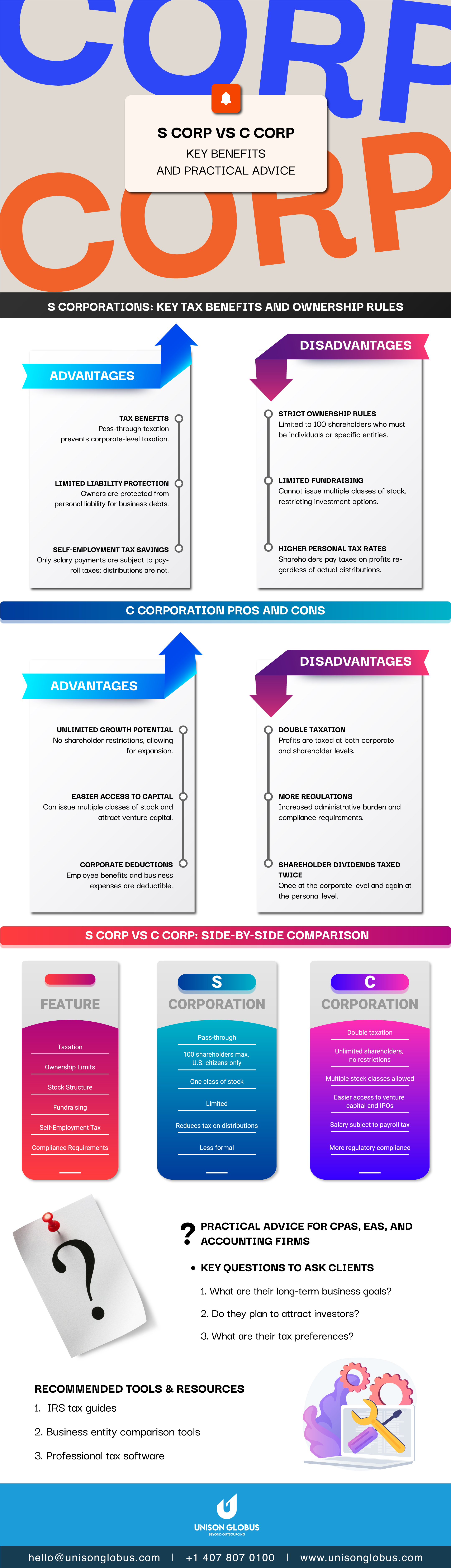
S Corporation vs C Corporation: A Side-by-Side Comparison

When structuring a business, choosing the right entity type is crucial for taxation, compliance, and long-term financial goals. Among the most common business structures in the U.S., S Corporations (S Corps) and C Corporations (C Corps) offer distinct advantages and limitations. While both provide liability protection and a corporate structure, their tax treatment, ownership restrictions, and operational requirements differ significantly.
For CPAs, EAs, and accounting professionals advising clients on business structures, understanding the nuances of S Corps vs. C Corps is essential. Let’s explore the key differences to help businesses make informed decisions.

S Understand S Corporations

Definition and Overview An S Corporation (S Corp) is a business entity that chooses to pass corporate income, deductions, and credits through to shareholders for tax purposes. This structure allows businesses to avoid double taxation while still benefiting from limited liability protection.
Formation and Eligibility To form an S Corporation, businesses must:
  • File Articles of Incorporation with the state.
  • Elect S Corporation status by submitting Form 2553 to the IRS.
  • Meet eligibility criteria, including:
  • No more than 100 shareholders.
  • Shareholders must be U.S. citizens or resident aliens.
  • Allowed shareholders: Individuals, certain trusts, and estates (no corporations or partnerships).
  • Only one class of stock is allowed.

C Understand C Corporations

Definition and Overview A C Corporation (C Corp) is a separate legal entity that provides limited liability to its owners but is subject to corporate taxation.
Formation and Eligibility To establish a C Corporation, businesses must:
  • File Articles of Incorporation with the state.
  • Adopt corporate bylaws and appoint directors.
  • Issue stock to shareholders.
  • Comply with state and federal reporting requirements.

Taxation: Pass-Through vs. Double Taxation S Corporation VS C Corporation

S Corporation:

  • Taxed as a pass-through entity, meaning income, deductions, and credits pass through to shareholders' personal tax returns.
  • Avoids double taxation since corporate earnings are not taxed at the entity level.
  • Shareholders pay taxes on profits at their individual income tax rates.
  • Must file Form 1120-S, but taxes are reported on Schedule K-1 for shareholders.

C Corporation:

  • Subject to double taxation—the corporation pays taxes at the entity level, and shareholders pay taxes on dividends.
  • Federal corporate tax rate: 21% (as per the Tax Cuts and Jobs Act - TCJA).
  • Dividends paid to shareholders are taxed at capital gains rates.
  • Must file Form 1120 for corporate taxes.
Key Takeaway: S Corps provide tax efficiency by avoiding double taxation, making them ideal for small businesses. However, C Corps offer tax planning flexibility and reinvestment advantages at the corporate level.

Ownership Structure & Restrictions S Corporation VS C Corporation

S Corporation:

  • Limited to 100 shareholders.
  • Shareholders must be U.S. citizens or resident aliens.
  • Only individuals, estates, and certain trusts can own shares (no corporations or partnerships as shareholders).
  • Can only issue one class of stock (voting and non-voting stock allowed, but no preferred stock).

C Corporation:

  • No ownership limits—can have unlimited shareholders.
  • It can be owned by individuals, corporations, partnerships, and foreign investors.
  • Can issue multiple classes of stock, including common and preferred shares.
Key Takeaway: S Corps are restrictive in ownership but simpler for closely held businesses. C Corps offer scalability and investment flexibility, making them preferable for businesses seeking venture capital or public offerings.

Self-Employment Taxes & Payroll Considerations S Corporation VS C Corporation

S Corporation:

  • Shareholders who work for the business must receive a reasonable salary (subject to payroll taxes).
  • Remaining profits (distributions) are not subject to self-employment tax.
  • Owners can minimize self-employment tax liability by structuring compensation strategically.

C Corporation:

  • All earnings paid as salary are subject to payroll taxes.
  • Dividends paid to shareholders are not subject to self-employment tax, but they are taxed separately at the shareholder level.
  • Employee benefits, such as health insurance, can be fully deductible at the corporate level.
Key Takeaway: S Corps provide a tax advantage by allowing distributions free from self-employment tax, but the IRS requires reasonable salary payments. C Corps provide more options for employee benefits but are subject to corporate and dividend taxation.

Need assistance choosing
between an S Corp and a C Corp?

Let Unison Globus guide you with expert tax and accounting advice. Contact us today for a consultation!

Compliance, Reporting, and Formalities S Corporation VS C Corporation

S Corporation:

  • Requires articles of incorporation and corporate bylaws.
  • Must elect S Corporation status by filing Form 2553 with the IRS.
  • Needs to hold annual meetings and maintain corporate minutes.
  • Fewer compliance requirements compared to C Corps.

C Corporation:

  • Requires more formalities, including regular board meetings, minutes, and shareholder meetings.
  • Subject to state-specific regulations and compliance.
  • More extensive record-keeping and documentation required.
Key Takeaway: S Corps have fewer administrative burdens, making them easier to manage. C Corps, while more complex, offer advantages for larger businesses with diverse stakeholders.

Business Growth & Fundraising Capabilities S Corporation VS C Corporation

S Corporation:

  • Limited fundraising options due to restrictions on ownership and stock issuance.
  • Typically funded through personal investments, business loans, or retained earnings.
  • Cannot attract venture capital or issue preferred stock.

C Corporation:

  • Better suited for raising capital through venture funding, stock issuance, or IPOs.
  • No ownership restrictions, allowing investors and institutional funding.
  • Ability to issue multiple stock classes provides strategic funding options.
Key Takeaway: For high-growth startups and businesses seeking external investors, C Corps are the preferred choice. S Corps work best for smaller, closely held businesses that do not plan to seek venture capital.

Which One is Right for Your Clients? S Corporation VS C Corporation

When advising clients, CPAs and EAs should assess the business’ size, growth plans, and tax preferences:
  • S Corporation is best for: small businesses, professional services firms, and owner-operated businesses seeking pass-through taxation and tax efficiency.
  • C Corporation is ideal for: larger businesses, startups planning to raise capital, and companies seeking investment flexibility.

Final Thoughts

The choice between an S Corporation and a C Corporation is pivotal in shaping a business’s financial and operational future. By carefully evaluating taxation, ownership rules, compliance obligations, and growth potential, businesses can make informed decisions aligned with their long-term objectives.
For personalized guidance, visit Unison Globus—our experts provide tailored accounting, taxation, and business structuring services to help your business thrive.
Contact us today to explore the best corporate structure for your business.

S Corp vs C Corp - Key Benefits and Pratical Advice S Corporation VS C Corporation

Categories
Accounting

The Secret of Growth: Expanding CPA Firm’s Potential with Non-Accounting Talent

In today’s fast-evolving financial landscape, CPA firms face mounting challenges to go beyond their traditional roles. To stay competitive, they must embrace innovation, diversify their expertise, and deliver value-added services that meet increasing client demands. While technical accounting skills remain critical, the integration of non-accounting talent can be a game changer for achieving growth and sustaining a competitive edge.
Unison Globus stands out as a reliable offshoring partner for CPAs, EAs, and accounting firms in the US, offering tailored solutions that enable firms to access a global pool of skilled professionals.
By partnering with Unison Globus, CPA firms can leverage not only accounting expertise but also the diverse talents needed to expand service offerings. Whether through innovative IT support, data analytics, or marketing solutions, Unison Globus enables firms to bridge talent gaps, drive operational efficiency, and achieve unparalleled growth.
This blog explores how integrating non-accounting talent into CPA firms can unlock new opportunities, expand capabilities, and position firms as leaders in the ever-changing accounting industry.

The Changing Landscape of CPA Firms 01

The accounting industry has witnessed a seismic transformation in recent years, shaped by rapid technological advancements, evolving client expectations, and an increased emphasis on advisory services. These changes present both challenges and opportunities for CPA firms to redefine their roles and enhance their value proposition.

01. From Compliance to Strategy

Traditionally, CPA firms focused on compliance tasks such as tax filing, auditing, and bookkeeping. However, the modern CPA firm is expected to deliver strategic insights that guide client decision-making. By expanding their roles to include advisory and consulting services, CPA firms can position themselves as indispensable partners in their clients’ financial journeys.

02. Adapting to Competitive Pressures

To stay relevant in an increasingly competitive market, CPA firms must innovate and diversify their offerings. Firms that fail to adapt risk being left behind as clients gravitate toward service providers offering more comprehensive and forward-thinking solutions. Innovation is no longer optional, it’s essential for survival and growth.

03. The Role of Technology

Technology has become a driving force in reshaping the accounting landscape:
  • AI and Automation: Automation tools are eliminating repetitive tasks, freeing up time for professionals to focus on higher-value services.
  • Data Analytics: Advanced analytics enable firms to uncover actionable insights and enhance decision-making.
  • Cloud Accounting: Cloud-based platforms provide real-time access to financial data, improving collaboration and efficiency.
For CPA firms, these technological shifts create opportunities to redefine their services and explore new avenues for growth. However, leveraging these tools effectively often requires expertise that extends beyond traditional accounting skills—a gap that non-accounting talent can fill.

Understanding Non-Accounting Talent 02

As CPA firms evolve to meet the demands of a modern, tech-driven marketplace, the inclusion of non-accounting talent has emerged as a powerful strategy for staying competitive. These professionals bring expertise that complements traditional accounting roles, helping firms diversify their service offerings and address complex client needs.

01. What is Non-Accounting Talent?

Non-accounting talent refers to individuals with specialized skills outside the core accounting domain but critical to enhancing a CPA firm’s capabilities. These professionals fill roles that support innovation, efficiency, and client satisfaction.

02. Examples of Non-Accounting Talent

Non-accounting professionals bring a wide array of skills to the table, including:
  • Data Analysts: Experts in analyzing financial and operational data, providing actionable insights that inform strategic decisions.
  • IT Specialists: Professionals skilled in managing and integrating accounting software, cybersecurity, and digital transformation initiatives.
  • Marketing Professionals: Experts in branding, client outreach, and digital marketing to help firms grow their client base.
  • Legal Advisors: Specialists offering guidance on regulatory compliance, contracts, and risk management.
  • HR Specialists: Experts in talent acquisition, employee engagement, and workforce management to build a strong organizational culture.

03. Filling Talent Gaps

Identifying and addressing talent gaps is critical for CPA firms aiming to meet diverse client demands. Non-accounting talent can play a pivotal role in:
  • Enhancing Service Offerings: Meeting client demands for broader services such as financial planning, IT consulting, and compliance support.
  • Addressing Emerging Needs: Filling roles that require expertise in technology integration, data visualization, or business strategy.

04. Adding Value to CPA Firms

Incorporating non-accounting talent brings a host of benefits, including:
  • Increased Efficiency: Streamlining operations with specialized expertise in technology and process improvement.
  • Fostering Innovation: Encouraging new perspectives and ideas that challenge the status quo.
  • Improved Client Experience: Offering a comprehensive range of services that meet diverse client needs, driving satisfaction and loyalty.
By integrating non-accounting talent, CPA firms can build a well-rounded team capable of delivering holistic solutions, setting themselves apart in an increasingly competitive landscape.

Benefits of Hiring Non-Accounting Talent 03

Incorporating non-accounting talent into a CPA firm’s workforce offers transformative advantages:
  • Expanded Services: Data analytics, IT integration, and business strategy consulting can elevate the firm’s offerings.
  • Enhanced Client Satisfaction: Diverse expertise enables CPA firms to cater to complex client needs effectively.
  • Innovation and Growth: Fresh perspectives foster creativity, leading to new service models and improved operational efficiency.

Transform Your CPA Firm Today!

Advance your firm’s potential with Unison Globus, the trusted offshoring partner for CPAs and accounting firms. Our tailored solutions connect you with diverse, skilled professionals who drive growth, innovation, and efficiency. Contact us now! Your growth journey begins here.

Strategies for Recruiting Non-Accounting Talent 04

Recruiting the right talent requires a thoughtful strategy:
  • Attracting Talent: Use targeted job descriptions emphasizing growth opportunities and impact.
  • Fostering Inclusion: Build a supportive culture where diverse skills are valued.
  • Partnering for Success: Collaborate with offshoring experts like Unison Globus to access a global pool of specialized professionals.

Overcoming Challenges 05

Integrating non-accounting talent into a CPA firm’s workforce can unlock significant opportunities for growth and innovation. However, this process is not without its challenges. By proactively addressing potential hurdles, CPA firms can ensure a seamless transition that maximizes the benefits of a diverse and skilled team.

01. Resistance to Change

Change often encounters resistance, particularly in industries with established practices like accounting.
  • Addressing Concerns: Employees may worry about job security or shifts in their roles. Open communication highlighting the benefits of non-accounting talent—such as improved efficiency, expanded services, and growth opportunities—can alleviate these fears.
  • Leadership Support: Strong leadership is critical. Firm leaders should champion the integration process, demonstrating commitment to the initiative and addressing concerns transparently.

02. Team Integration

Introducing non-accounting professionals into existing teams requires thoughtful planning to ensure alignment and collaboration.
  • Cross-Functional Training: Provide training programs that enable team members to understand and leverage the expertise of non-accounting professionals. For example, accountants could learn how data analytics enhances financial reporting.
  • Team-Building Activities: Foster a culture of collaboration by organizing activities that help build rapport and mutual understanding among team members from different disciplines.
  • Clear Roles and Expectations: Clearly define the roles and responsibilities of non-accounting talent to avoid confusion and overlap with existing positions.

03. Ongoing Development

The accounting industry is constantly evolving, making it crucial for all team members—accounting and non-accounting alike—to stay updated on industry trends and skills.
  • Continuous Learning Opportunities: Invest in professional development programs, certifications, and workshops to enhance skillsets and keep the workforce competitive.
  • Encouraging Lifelong Learning: Foster a culture where employees are encouraged to upskill regularly, ensuring the firm remains at the forefront of industry advancements.
  • Mentorship Programs: Pair non-accounting professionals with seasoned staff members to facilitate knowledge sharing and mutual growth.

04. Cultural Alignment

Integrating non-accounting talent isn’t just about skills—it’s about building a cohesive workforce.
  • Inclusive Workplace Policies: Create policies that promote inclusivity and ensure all employees feel valued, regardless of their professional background.
  • Celebrating Successes: Recognize and celebrate milestones achieved through cross-disciplinary collaboration, reinforcing the value of a diverse workforce.
By tackling these challenges head-on, CPA firms can create an environment where non-accounting talent thrives alongside traditional roles, driving innovation, efficiency, and growth.

Final Thoughts

Expanding CPA firms’ potential through non-accounting talent is not just an option, it’s a necessity for sustainable growth. Unison Globus offers unparalleled offshoring solutions, providing access to diverse, skilled professionals who can help CPA firms thrive in an evolving marketplace.

Ready to transform your workforce?

Explore Unison Globus’s services and discover how our expertise can empower your firm to achieve unparalleled success.
Categories
Accounting

2025 Financial Outlook: COLA Adjustments and Asset Management Trends

As we step into 2025, financial professionals, businesses, and individuals are navigating a landscape shaped by economic shifts, legislative changes, and evolving market dynamics. For US-based CPAs, EAs, and accounting firms, staying informed about these trends is essential to offering effective guidance to clients. This article explores the key aspects of the 2025 financial outlook, focusing on Cost-of-Living Adjustments (COLA) and asset management trends, while highlighting strategies for maximizing opportunities in a complex economic environment.

Understanding the 2025 Financial Landscape

01. Economic Growth Projections

The global economy is anticipated to grow modestly in 2025, with varying impacts across regions. Market predictions indicate that while certain sectors like technology and green energy will see robust growth, others may face challenges due to inflationary pressures and geopolitical uncertainties. Financial planning must account for these nuances, tailoring strategies to clients’ unique circumstances.

02. Inflation and Its Impact on Investments

Persistent inflation continues to influence financial stability and investment returns. For accounting firms, understanding inflation’s impact on retirement planning, asset allocation, and wealth management is crucial. Inflation-adjusted strategies can help clients protect their portfolios and maintain purchasing power.

How Do Cost of Living Adjustments (COLAs) Operate and What Is It?

A Cost of Living Adjustment (COLA) is an annual change in monetary benefits aimed at offsetting the effects of inflation. These adjustments ensure that beneficiaries of programs such as Social Security and federal retirement plans maintain their purchasing power despite rising living costs. COLA prevents the deterioration of income value due to inflation, providing financial stability to recipients.

How COLA Works

  • Calculation Basis: COLA is typically determined based on changes in the Consumer Price Index for Urban Wage Earners and Clerical Workers (CPI-W). When the CPI-W reflects an increase in inflation, corresponding adjustments are made to benefits.
  • Implementation: The Social Security Administration (SSA) and other regulatory bodies announce COLA changes annually, usually taking effect at the start of the calendar year.
  • Application to Benefits: The adjustment applies to retirement benefits, pensions, and other income-dependent programs, ensuring recipients’ income adjusts in line with inflation.
For US-based CPAs, EAs, and accounting firms, understanding COLA calculations is essential for advising clients on retirement and tax planning strategies. By leveraging COLA updates, firms can help clients optimize their financial plans and safeguard long-term goals.

Key COLA Adjustments in 2025

01. Key Updates for 2025

  • The annual compensation limit under Section 401(a)(17) has increased to $350,000 from $345,000 in 2024.
  • Elective deferral limits under Section 402(g)(1) have risen to $23,500, up from $23,000.
  • SIMPLE plan contributions have increased to $16,500, reflecting rising thresholds.

For more details, professionals can visit the Centre of Excellence.

02. COLA’s Impact on Investments

COLA adjustments influence long-term planning by altering the dynamics of fixed-income investments and retirement distributions. For example, retirees relying on fixed benefits may see an increase in payouts, which can impact the sustainability of retirement portfolios.

Maximize Your Potential in
2025 with Unison Globus!

Empower your practice with expert outsourcing solutions tailored for US-based CPAs, EAs, and accounting firms. Streamline your accounting, taxation, and management tasks while focusing on strategic growth. Contact us today to unlock success in 2025!

Asset Management Trends for 2025

01. The Future of Asset Management

Asset management in 2025 is defined by technological integration, ESG (Environmental, Social, and Governance) considerations, and a focus on personalization. Firms are leveraging AI-driven tools to provide data-backed investment advice, offering a competitive edge.

02. Emerging Trends

  • Sustainable Investing: The demand for ESG-compliant investments continues to grow, prompting firms to prioritize sustainability in their offerings.
  • Digital Transformation: Automation and blockchain technology are streamlining processes, reducing costs, and enhancing transparency.
  • Customized Solutions: Personal finance tips tailored to individual goals are becoming the norm, requiring firms to adopt a more client-centric approach.

Strategic Insights for Financial Professionals

01. Investment Opportunities in 2025

Market analysis points to lucrative opportunities in renewable energy, technology, and healthcare sectors. Diversification and proactive market predictions are vital for capitalizing on these trends.

02. Wealth Management Strategies

Wealth management in 2025 emphasizes holistic planning, integrating tax-efficient investment strategies, estate planning, and retirement solutions. CPAs and EAs can differentiate their services by offering comprehensive solutions that address both immediate and long-term financial goals.

03. Personal Finance and Retirement Planning

Encouraging clients to focus on retirement planning and personal finance tips is crucial. By aligning investment advice with clients’ life stages and goals, financial professionals can build stronger, lasting relationships.

Why Choose Unison Globus?

At Unison Globus, we specialize in empowering US-based CPAs, EAs, and accounting firms with expert outsourcing solutions. Our services streamline accounting, taxation, and management tasks, enabling firms to focus on strategic growth and client satisfaction.

Contact Us Today

Stay ahead in 2025 by partnering with Unison Globus. Our team of professionals is here to support your financial success.
Contact us today to explore how we can add value to your practice.

Conclusion

The 2025 financial outlook presents both challenges and opportunities. By understanding COLA adjustments and asset management trends, financial professionals can guide clients toward stability and growth. With the right strategies, tools, and partnerships, 2025 can be a year of remarkable success for CPAs, EAs, and accounting firms.

2025 Highlights to Watch

As we step into 2025, businesses leveraging offshore accounting are poised to benefit from groundbreaking innovations:
  • Economic Growth Projections: Moderate global growth with focus sectors like technology and renewable energy poised for expansion.
  • Retirement Planning Updates: Increased thresholds for SIMPLE and SEP plans—ideal for small business clients.
  • Global Economic Trends: Heightened geopolitical uncertainties necessitate a diversified approach to international investments.
  • Personal Finance Opportunities: High-yield savings accounts and structured annuities gaining popularity for risk-averse clients.
By incorporating these updates and tips, CPAs, EAs, and accounting firms can enhance their services, helping clients navigate the challenges and opportunities of 2025 with confidence.