

Summarize and analyze this article with:
Accounting has always relied on accurate data, consistent processes and careful review. But the way finance teams handle these responsibilities is changing.
Artificial intelligence (AI) and automation are now helping businesses process financial information faster, reduce repetitive work and generate more useful insights from their data.
For finance teams, this does not simply mean replacing manual tasks with software. The bigger opportunity is to move away from time-consuming administrative work and spend more time on analysis, planning and decision-making.
So, how exactly is AI changing accounting, and what does this mean for businesses?
What is AI in finance and accounting?
AI in finance refers to the use of artificial intelligence and related technologies to analyse financial data, automate processes, identify patterns and support decision-making.
Automation and AI are related, but they are not the same.
Traditional automation generally follows predefined rules. For example, an automated system may match an invoice with a purchase order or send a payment reminder when an invoice becomes overdue.
AI can go further. It can identify patterns in large amounts of data, highlight unusual transactions, support forecasting and generate summaries or reports.
Generative AI adds another layer by helping finance teams work with text and unstructured information. It can, for example, help draft management commentary, summarise financial results or support scenario analysis.
The distinction matters because businesses can use different technologies for different finance processes.
How is AI transforming accounting
AI is already being applied across several areas of finance and accounting. Some of the most practical applications include:
1. Automating data entry and processing
Manual data entry can take up a significant amount of time, particularly when finance teams deal with large numbers of invoices, receipts and financial documents.
AI-powered systems can extract information from documents and transfer relevant data into accounting or finance systems.
This can reduce repetitive work and minimise the risk of simple manual errors.
The benefit is not only speed. Finance professionals can spend less time moving information between systems and more time checking whether the information makes sense.
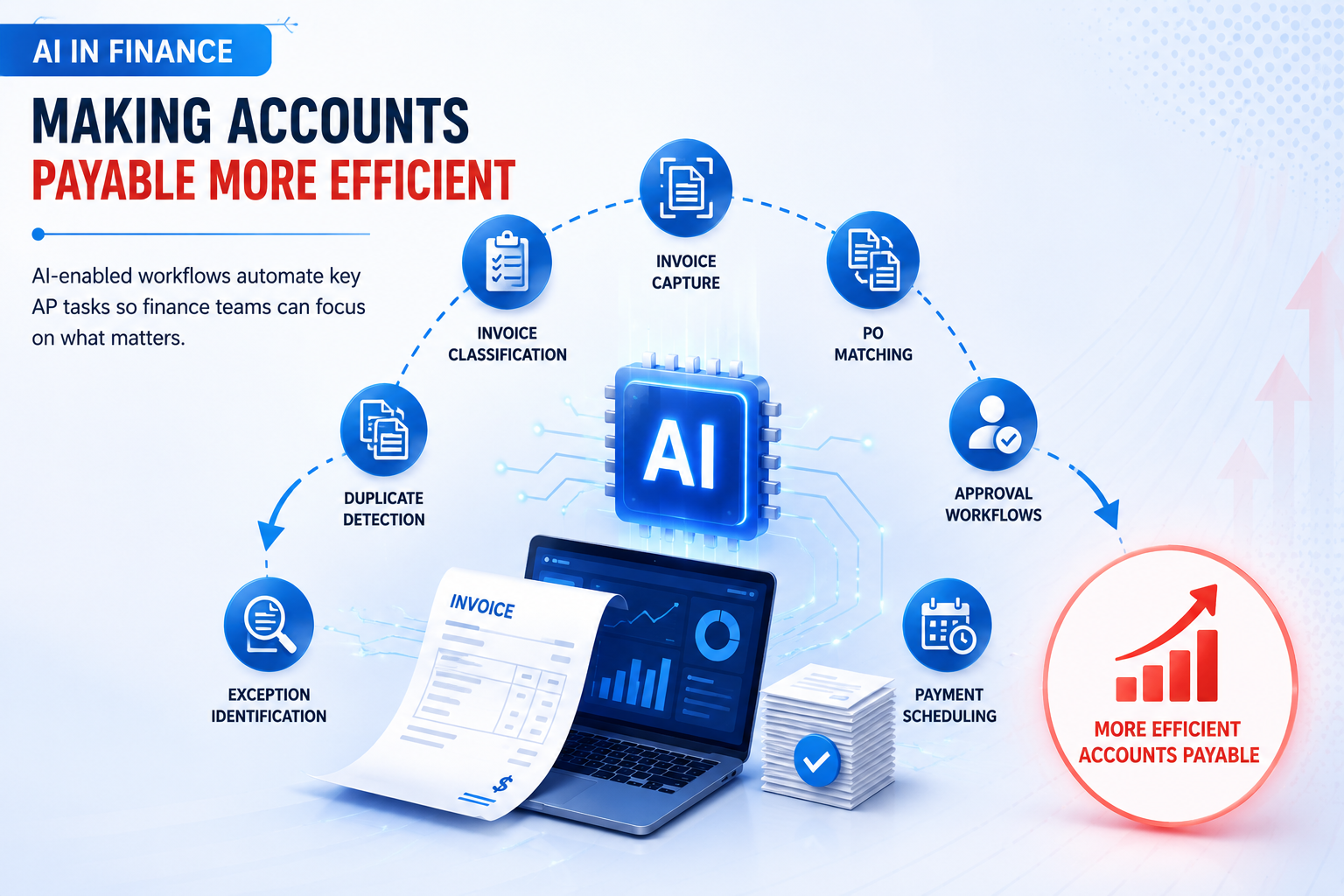
2. Making accounts payable more efficient
Accounts payable is another area where automation can make a noticeable difference.
AI-enabled workflows can help with:
- Invoice capture and classification
- Purchase order matching
- Duplicate invoice identification
- Approval workflows
- Payment scheduling
- Supplier queries
- Exception identification
Instead of reviewing every transaction manually, finance teams can focus their attention on transactions that require investigation or approval.
This approach can make the accounts payable process more efficient while maintaining appropriate human oversight.
3. Improving bank reconciliation
Bank reconciliation can be repetitive, especially when businesses have a large number of transactions across multiple accounts.
AI and automation can help match transactions between bank statements and accounting records. Where the system identifies a straightforward match, the process can be completed automatically.
Unusual or unmatched transactions can then be highlighted for review.
This creates a more efficient workflow because accountants are not spending the same amount of time checking transactions that can already be matched confidently.
4. Supporting fraud and anomaly detection
AI can analyse large volumes of transactions and identify patterns that may be difficult to spot through manual review.
For example, a system may highlight:
- Unusual payment amounts
- Duplicate transactions
- Unexpected changes in spending
- Irregular supplier activity
- Unusual expense claims
- Transactions that differ from normal patterns
This does not mean AI can determine that a transaction is fraudulent on its own.
Instead, it can help finance teams identify areas that deserve closer attention.
AICPA & CIMA notes that AI tools can support risk assessment by examining large volumes of financial and procurement data for anomalies, errors and potential fraud.
5. Faster financial reporting
Financial reporting often involves collecting information from different systems, checking figures and preparing commentary.
AI can help automate parts of this process.
For example, finance teams can use AI to:
- Pull together information from multiple sources
- Identify significant variances
- Summarise financial performance
- Draft initial management commentary
- Highlight changes in key financial metrics
- Support recurring reporting processes
This can shorten reporting cycles and allow finance professionals to spend more time interpreting the results.
The goal is not simply to produce reports faster. It is to help businesses understand what the numbers mean.
How can AI improve financial forecasting?
Forecasting is one of the areas where AI can provide significant value.
Traditional forecasting often relies heavily on historical data, assumptions and manual spreadsheet analysis. AI can analyse larger datasets and identify patterns that may be difficult to identify manually.
Depending on the system and quality of the underlying data, AI can support:
- Revenue forecasting
- Cash flow forecasting
- Expense forecasting
- Working capital analysis
- Demand planning
- Scenario modelling
- Budget variance analysis
For example, rather than simply reporting that costs have increased, an AI-enabled system may help identify which cost categories, locations or business activities are contributing to the change.
This gives finance leaders more information to support their decisions.
For businesses looking to strengthen their forecasting, scenario planning and financial decision-making capabilities, choosing the right FP&A outsourcing partner can provide additional expertise and support. Learn more about how to choose an FP&A outsourcing partner for your business.
However, forecasting is only as reliable as the data and assumptions behind it. AI-generated outputs still need to be reviewed and challenged by finance professionals. AICPA & CIMA specifically highlights the importance of verifying AI findings and maintaining professional judgement.
AI can move finance from reporting to insight
One of the biggest changes AI can bring to accounting is the shift from backward-looking reporting towards more forward-looking analysis.
Traditional accounting often answers questions such as:
What happened?
AI-supported finance can help teams explore additional questions:
Why did it happen?
What is likely to happen next?
What could happen if we change our assumptions?
Where should management focus its attention?
This is particularly valuable for CFOs and senior leadership teams.
McKinsey’s research into finance teams using AI found applications across areas such as forecasting, working capital management, reporting and cost optimisation. It also reported that finance professionals in some functions were spending less time on data processing and more time supporting business decisions.
What are the benefits of AI automation in accounting?
For businesses considering AI adoption, the potential benefits go beyond simply reducing manual work.
Greater efficiency: Automating repetitive processes can reduce the amount of time finance teams spend on routine administration.
Fewer manual errors: Automated workflows can reduce errors associated with repetitive data entry, calculations and transaction processing.
Faster access to information: AI can help finance teams process and analyse information more quickly, supporting faster reporting and decision-making.
Better financial visibility: When financial information is processed more consistently, businesses can gain a clearer view of cash flow, costs, performance and working capital.
More time for strategic work: Perhaps the most important benefit is the ability to redirect finance professionals towards analysis, planning and business partnering.
AICPA & CIMA describes AI as a technology that can automate routine processes while helping finance professionals focus more on analysis, insight and advisory work.
Does AI replace accountants?
This is one of the most common concerns surrounding AI in accounting.
The more realistic answer is that AI is likely to change the work accountants do rather than simply eliminate the profession.
Routine and repetitive activities are increasingly suitable for automation. But accounting also requires professional judgement, interpretation, communication, ethics and an understanding of business context.
For example, an AI system may identify an unusual transaction. An accountant still needs to determine why it happened, whether it is appropriate and what action should be taken.
Similarly, AI may generate a financial forecast, but a finance leader needs to assess whether the assumptions are reasonable and how the forecast should influence business decisions.
ACCA has highlighted that AI is expected to reshape how accounting tasks are completed, while human intervention remains important at critical points.
The role of the accountant is therefore becoming less focused on processing information and increasingly focused on interpreting it.
What are the risks of using AI in accounting?
AI offers significant opportunities, but businesses should not adopt it without considering the risks.
Data security: Financial information is highly sensitive. Businesses need to understand where data is stored, how it is processed and who can access it.
Data quality: Poor-quality financial data can lead to poor-quality AI outputs.
The principle is simple:
Better data leads to better analysis.
Lack of human oversight: AI can produce incorrect or misleading results. Important financial decisions should not be based solely on an automated output.
Integration challenges: AI tools need to work effectively with existing accounting, ERP, payroll, CRM and banking systems. Poor integration can create additional work rather than reducing it.
Skills gaps: Finance teams need to understand not only how to use AI tools but also how to review their outputs and identify potential limitations.
A 2025 AICPA & CIMA survey of 1,446 finance and accounting leaders and managers found that 88% believed AI would be the most transformative technology trend in accounting and finance over the following 12–24 months, while only 8% felt their organisation was very well prepared to manage the trend.
This highlights an important point: adopting AI is as much about people, processes and governance as it is about technology.
How should businesses start using AI in finance?
Businesses do not need to automate everything at once.
A more practical approach is to identify finance processes where automation can deliver a clear benefit.
Start by asking:
Which processes are repetitive?
Where are teams spending too much time on manual data processing?
Which tasks regularly create delays or errors?
Where would faster financial information improve decision-making?
From there, businesses can select one or two suitable processes and measure the results.
For example, a company might begin with invoice processing or bank reconciliation before moving into more advanced applications such as forecasting and scenario modelling.
This phased approach makes it easier to understand the technology, train employees and establish appropriate controls.
What does the future of AI in accounting look like?
AI is likely to become increasingly embedded into everyday finance processes.
The next stage will not simply involve individual AI tools performing isolated tasks. Businesses are increasingly exploring connected workflows where AI can help move information between processes, identify issues and support decisions.
This could mean finance teams spending less time collecting and preparing information and more time interpreting financial performance.
However, successful adoption will depend on having the right foundations in place.
Businesses will need:
- Reliable financial data
- Well-defined processes
- Appropriate technology integration
- Clear governance
- Strong data security
- Skilled finance professionals
- Human review and accountability
PwC’s 2025 analysis highlighted a similar shift from AI experimentation towards focused finance workflows, measurable business outcomes and stronger governance, including human oversight.
Final Thoughts
AI is changing accounting, but its biggest impact may not be the automation of individual tasks.
The real opportunity is to create a finance function that can process information faster, identify important changes earlier and provide better insight to the wider business.
Routine accounting activities can increasingly be automated. This gives finance professionals more time to focus on the areas where human judgement matters most — financial planning, analysis, forecasting and strategic decision-making.
For businesses, the question is therefore not simply whether AI should be adopted.
It is where AI can create the most practical value, and how it can be introduced without compromising accuracy, security or professional judgement.
With the right approach, AI can become less about replacing finance teams and more about helping them work more efficiently and become stronger strategic partners to the business.
Sources & References
- AICPA & CIMA – AI in Accounting and Finance: Navigating Rapid Change (AICPA & CIMA)
- AICPA & CIMA – AI Resources for Accounting and Finance (AICPA & CIMA)
- McKinsey – How Finance Teams Are Putting AI to Work Today (McKinsey & Company)
- ACCA – AI Is Reshaping the Work of Accountants (ACCA Global)
- AICPA & CIMA – Future-Ready Finance: Technology, Productivity and Skills Survey (AICPA & CIMA)
- PwC – AI: Finance Is Shifting from Pilots to Performance (PwC)

