

Categories
Financial Planning & Analysis

AI in Finance: How Automation Is Transforming Accounting

Accounting has always relied on accurate data, consistent processes and careful review. But the way finance teams handle these responsibilities is changing.

Artificial intelligence (AI) and automation are now helping businesses process financial information faster, reduce repetitive work and generate more useful insights from their data.

For finance teams, this does not simply mean replacing manual tasks with software. The bigger opportunity is to move away from time-consuming administrative work and spend more time on analysis, planning and decision-making.

So, how exactly is AI changing accounting, and what does this mean for businesses?

What is AI in finance and accounting?

AI in finance refers to the use of artificial intelligence and related technologies to analyse financial data, automate processes, identify patterns and support decision-making.


Automation and AI are related, but they are not the same.


Traditional automation generally follows predefined rules. For example, an automated system may match an invoice with a purchase order or send a payment reminder when an invoice becomes overdue.


AI can go further. It can identify patterns in large amounts of data, highlight unusual transactions, support forecasting and generate summaries or reports.


Generative AI adds another layer by helping finance teams work with text and unstructured information. It can, for example, help draft management commentary, summarise financial results or support scenario analysis.


The distinction matters because businesses can use different technologies for different finance processes.

How is AI transforming accounting

AI is already being applied across several areas of finance and accounting. Some of the most practical applications include:


1. Automating data entry and processing

Manual data entry can take up a significant amount of time, particularly when finance teams deal with large numbers of invoices, receipts and financial documents.


AI-powered systems can extract information from documents and transfer relevant data into accounting or finance systems.


This can reduce repetitive work and minimise the risk of simple manual errors.


The benefit is not only speed. Finance professionals can spend less time moving information between systems and more time checking whether the information makes sense.
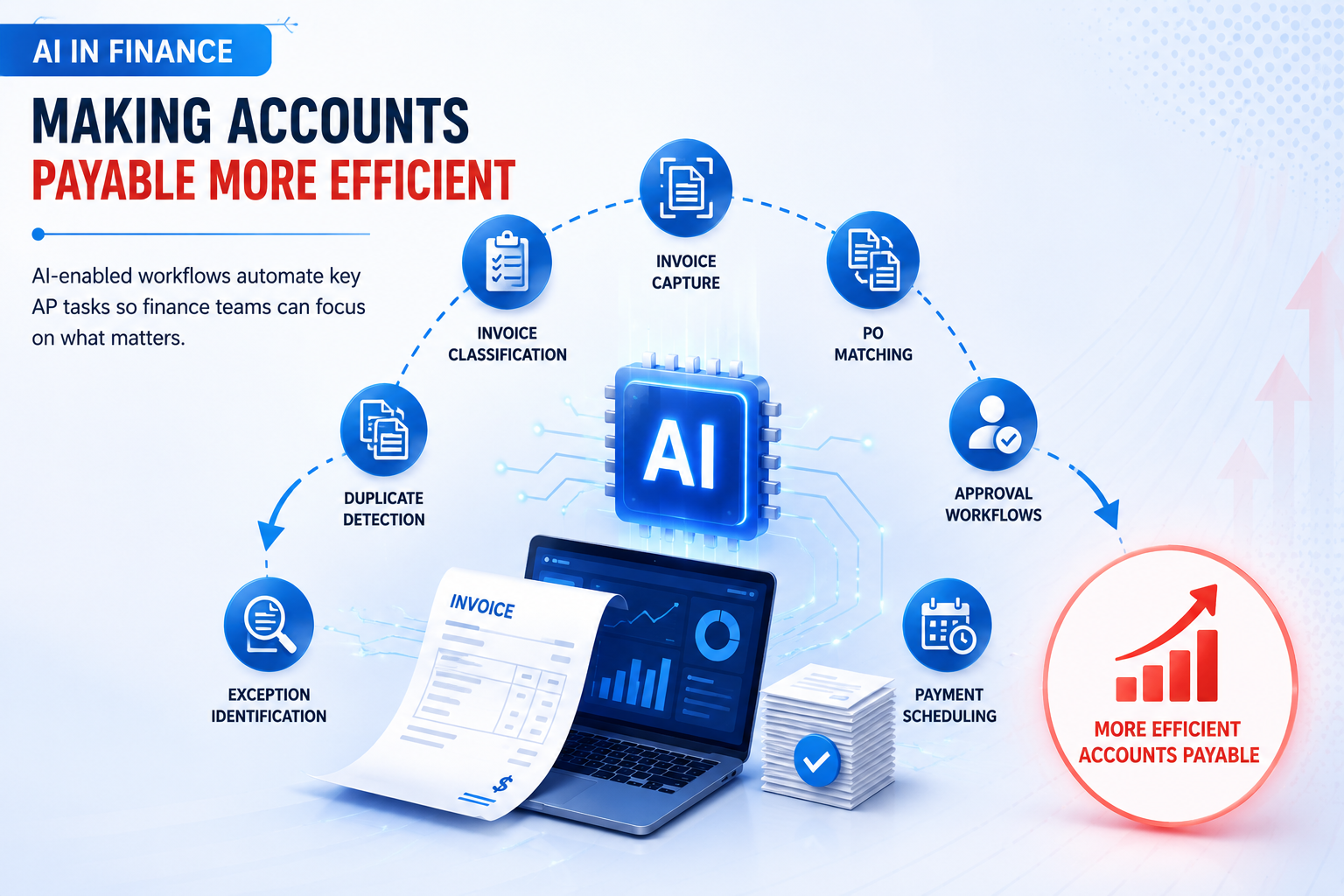
 

2. Making accounts payable more efficient

Accounts payable is another area where automation can make a noticeable difference.


AI-enabled workflows can help with:

  • Invoice capture and classification
  • Purchase order matching
  • Duplicate invoice identification
  • Approval workflows
  • Payment scheduling
  • Supplier queries
  • Exception identification


Instead of reviewing every transaction manually, finance teams can focus their attention on transactions that require investigation or approval.


This approach can make the accounts payable process more efficient while maintaining appropriate human oversight.

3. Improving bank reconciliation

Bank reconciliation can be repetitive, especially when businesses have a large number of transactions across multiple accounts.


AI and automation can help match transactions between bank statements and accounting records. Where the system identifies a straightforward match, the process can be completed automatically.


Unusual or unmatched transactions can then be highlighted for review.


This creates a more efficient workflow because accountants are not spending the same amount of time checking transactions that can already be matched confidently.

4. Supporting fraud and anomaly detection

AI can analyse large volumes of transactions and identify patterns that may be difficult to spot through manual review.


For example, a system may highlight:

  • Unusual payment amounts
  • Duplicate transactions
  • Unexpected changes in spending
  • Irregular supplier activity
  • Unusual expense claims
  • Transactions that differ from normal patterns


This does not mean AI can determine that a transaction is fraudulent on its own.


Instead, it can help finance teams identify areas that deserve closer attention.


AICPA & CIMA notes that AI tools can support risk assessment by examining large volumes of financial and procurement data for anomalies, errors and potential fraud.

5. Faster financial reporting

Financial reporting often involves collecting information from different systems, checking figures and preparing commentary.


AI can help automate parts of this process.


For example, finance teams can use AI to:

  • Pull together information from multiple sources
  • Identify significant variances
  • Summarise financial performance
  • Draft initial management commentary
  • Highlight changes in key financial metrics
  • Support recurring reporting processes


This can shorten reporting cycles and allow finance professionals to spend more time interpreting the results.


The goal is not simply to produce reports faster. It is to help businesses understand what the numbers mean.

How can AI improve financial forecasting?

Forecasting is one of the areas where AI can provide significant value.


Traditional forecasting often relies heavily on historical data, assumptions and manual spreadsheet analysis. AI can analyse larger datasets and identify patterns that may be difficult to identify manually.

Depending on the system and quality of the underlying data, AI can support:

  • Revenue forecasting
  • Cash flow forecasting
  • Expense forecasting
  • Working capital analysis
  • Demand planning
  • Scenario modelling
  • Budget variance analysis


For example, rather than simply reporting that costs have increased, an AI-enabled system may help identify which cost categories, locations or business activities are contributing to the change.


This gives finance leaders more information to support their decisions.


For businesses looking to strengthen their forecasting, scenario planning and financial decision-making capabilities, choosing the right FP&A outsourcing partner can provide additional expertise and support. Learn more about how to choose an FP&A outsourcing partner for your business.


However, forecasting is only as reliable as the data and assumptions behind it. AI-generated outputs still need to be reviewed and challenged by finance professionals. AICPA & CIMA specifically highlights the importance of verifying AI findings and maintaining professional judgement.

AI can move finance from reporting to insight

One of the biggest changes AI can bring to accounting is the shift from backward-looking reporting towards more forward-looking analysis.


Traditional accounting often answers questions such as:


What happened?


AI-supported finance can help teams explore additional questions:


Why did it happen?


What is likely to happen next?


What could happen if we change our assumptions?


Where should management focus its attention?

This is particularly valuable for CFOs and senior leadership teams.


McKinsey’s research into finance teams using AI found applications across areas such as forecasting, working capital management, reporting and cost optimisation. It also reported that finance professionals in some functions were spending less time on data processing and more time supporting business decisions.

What are the benefits of AI automation in accounting?

For businesses considering AI adoption, the potential benefits go beyond simply reducing manual work.


Greater efficiency: Automating repetitive processes can reduce the amount of time finance teams spend on routine administration.


Fewer manual errors: Automated workflows can reduce errors associated with repetitive data entry, calculations and transaction processing.


Faster access to information: AI can help finance teams process and analyse information more quickly, supporting faster reporting and decision-making.


Better financial visibility: When financial information is processed more consistently, businesses can gain a clearer view of cash flow, costs, performance and working capital.


More time for strategic work: Perhaps the most important benefit is the ability to redirect finance professionals towards analysis, planning and business partnering.


AICPA & CIMA describes AI as a technology that can automate routine processes while helping finance professionals focus more on analysis, insight and advisory work.

Does AI replace accountants?

This is one of the most common concerns surrounding AI in accounting.


The more realistic answer is that AI is likely to change the work accountants do rather than simply eliminate the profession.


Routine and repetitive activities are increasingly suitable for automation. But accounting also requires professional judgement, interpretation, communication, ethics and an understanding of business context.


For example, an AI system may identify an unusual transaction. An accountant still needs to determine why it happened, whether it is appropriate and what action should be taken.


Similarly, AI may generate a financial forecast, but a finance leader needs to assess whether the assumptions are reasonable and how the forecast should influence business decisions.


ACCA has highlighted that AI is expected to reshape how accounting tasks are completed, while human intervention remains important at critical points.


The role of the accountant is therefore becoming less focused on processing information and increasingly focused on interpreting it.

What are the risks of using AI in accounting?

AI offers significant opportunities, but businesses should not adopt it without considering the risks.


Data security: Financial information is highly sensitive. Businesses need to understand where data is stored, how it is processed and who can access it.


Data quality: Poor-quality financial data can lead to poor-quality AI outputs.


The principle is simple:


Better data leads to better analysis.


Lack of human oversight: AI can produce incorrect or misleading results. Important financial decisions should not be based solely on an automated output.


Integration challenges: AI tools need to work effectively with existing accounting, ERP, payroll, CRM and banking systems. Poor integration can create additional work rather than reducing it.


Skills gaps: Finance teams need to understand not only how to use AI tools but also how to review their outputs and identify potential limitations.


A 2025 AICPA & CIMA survey of 1,446 finance and accounting leaders and managers found that 88% believed AI would be the most transformative technology trend in accounting and finance over the following 12–24 months, while only 8% felt their organisation was very well prepared to manage the trend.


This highlights an important point: adopting AI is as much about people, processes and governance as it is about technology.

How should businesses start using AI in finance?

Businesses do not need to automate everything at once.


A more practical approach is to identify finance processes where automation can deliver a clear benefit.


Start by asking:


Which processes are repetitive?


Where are teams spending too much time on manual data processing?


Which tasks regularly create delays or errors?


Where would faster financial information improve decision-making?


From there, businesses can select one or two suitable processes and measure the results.


For example, a company might begin with invoice processing or bank reconciliation before moving into more advanced applications such as forecasting and scenario modelling.


This phased approach makes it easier to understand the technology, train employees and establish appropriate controls.

What does the future of AI in accounting look like?

AI is likely to become increasingly embedded into everyday finance processes.


The next stage will not simply involve individual AI tools performing isolated tasks. Businesses are increasingly exploring connected workflows where AI can help move information between processes, identify issues and support decisions.


This could mean finance teams spending less time collecting and preparing information and more time interpreting financial performance.


However, successful adoption will depend on having the right foundations in place.


Businesses will need:

  • Reliable financial data
  • Well-defined processes
  • Appropriate technology integration
  • Clear governance
  • Strong data security
  • Skilled finance professionals
  • Human review and accountability


PwC’s 2025 analysis highlighted a similar shift from AI experimentation towards focused finance workflows, measurable business outcomes and stronger governance, including human oversight.

Final Thoughts

AI is changing accounting, but its biggest impact may not be the automation of individual tasks.


The real opportunity is to create a finance function that can process information faster, identify important changes earlier and provide better insight to the wider business.


Routine accounting activities can increasingly be automated. This gives finance professionals more time to focus on the areas where human judgement matters most — financial planning, analysis, forecasting and strategic decision-making.


For businesses, the question is therefore not simply whether AI should be adopted.


It is where AI can create the most practical value, and how it can be introduced without compromising accuracy, security or professional judgement.


With the right approach, AI can become less about replacing finance teams and more about helping them work more efficiently and become stronger strategic partners to the business.

Sources & References

  • AICPA & CIMA – AI in Accounting and Finance: Navigating Rapid Change (AICPA & CIMA)
  • AICPA & CIMA – AI Resources for Accounting and Finance (AICPA & CIMA)
  • McKinsey – How Finance Teams Are Putting AI to Work Today (McKinsey & Company)
  • ACCA – AI Is Reshaping the Work of Accountants (ACCA Global)
  • AICPA & CIMA – Future-Ready Finance: Technology, Productivity and Skills Survey (AICPA & CIMA)
  • PwC – AI: Finance Is Shifting from Pilots to Performance (PwC)
Categories
Financial Planning & Analysis

How to Choose an FP&A Outsourcing Partner for Your Business

Many businesses reach a stage where basic financial reporting is no longer enough. The accounts may show what happened last month, but leadership needs to know what is likely to happen next, where cash pressure may come from, which costs are moving, and whether the business can support its next decision.

This is where FP&A becomes important.

FP&A, or financial planning and analysis, helps businesses connect finance with future planning. It covers budgeting, forecasting, variance analysis, scenario modelling, cash flow visibility, KPI reporting, and decision support. Gartner describes FP&A teams as playing a critical role in financial strategy by supporting budgeting, forecasting, and analysis for business leaders.

For many startups, SMEs, and growing companies, hiring a full internal FP&A team may not be practical. Outsourcing can be a sensible alternative, but only if the partner is chosen carefully. The right FP&A outsourcing partner should not simply prepare reports. They should help the business understand its numbers, plan with more confidence, and make better commercial decisions.

Start by understanding what you really need

Before choosing a partner, the business should first be clear about what it wants FP&A support to solve.


Some businesses need better budgeting because spend is becoming harder to control. Some need cash flow forecasting because they are growing quickly but collections and supplier payments are becoming uneven. Others need investor reporting, board packs, profitability analysis, pricing support, or scenario planning before entering a new market.


This clarity matters because FP&A is not one fixed service. A startup may need a simple monthly dashboard and cash runway model. A multi-entity business may need consolidated reporting, department-wise budgets, and rolling forecasts. A founder-led company may need someone who can translate numbers into practical business decisions.


A good FP&A partner should ask questions before offering a solution. If the first conversation goes straight into templates and generic reports, that may be a sign that the partner is not taking enough time to understand the business.

If your current reports show what happened but not what to do next, you may need structured FP&A support. You can explore Unison Direct’s UK FP&A support here: financial planning and analysis services in the UK.

Explore UK FP&A Services
Financial planning and analysis professionals

Look for business understanding, not just finance skills

FP&A is different from routine accounting. Accounting tells you what has already happened. FP&A helps you understand what may happen next and what decisions can improve the outcome.


This means the partner should understand more than numbers. They should be able to understand your revenue model, cost structure, customer behaviour, margins, operational drivers, hiring plans, seasonality, funding needs, and growth priorities.


For example, if you run a SaaS business, the partner should understand recurring revenue, churn, customer acquisition cost, lifetime value, and cash runway. If you run an e-commerce business, they should understand stock, fulfilment costs, returns, advertising spend, contribution margin, and working capital. If you run a professional services business, they should understand utilisation, billing rates, project margins, and capacity planning.


The stronger the business understanding, the more useful the financial analysis becomes.

Check whether they can explain the story behind the numbers

A useful FP&A partner should not only send spreadsheets. They should explain what the numbers mean.

If revenue is up, why is cash still tight?


If margins are falling, where is the pressure coming from?


If sales are growing, can the business afford the extra staff?


If costs are rising, are they linked to growth or inefficiency?


If a new service line is profitable, should it receive more investment?


This is where many businesses feel the real value of FP&A. It turns data into decision support.


ACCA notes that planning, budgeting, and forecasting should help the business understand how its ongoing activities contribute to longer-term strategy. It also highlights the importance of bringing financial and operational planning closer together. This is a useful way to judge an FP&A partner. They should not work in isolation from the business. They should connect finance with operations, sales, delivery, and leadership.

Review their forecasting approach

Forecasting is one of the most important parts of FP&A. But not all forecasting is useful.


A weak forecast is just last year’s numbers with a percentage increase. A strong forecast is built around the real drivers of the business. This may include sales pipeline, customer retention, headcount, pricing, gross margin, operating costs, payment cycles, hiring plans, and market assumptions.


The partner should be able to explain how they build forecasts, how often they refresh them, what assumptions they use, and how they handle uncertainty. Rolling forecasts are often more useful than static annual budgets because they can be updated as the business changes.


This is especially important in 2026, when many businesses are managing cost pressure, changing customer demand, higher financing expectations, and the need for sharper cash control. The British Business Bank’s Small Business Finance Markets Report 2026 notes that around half of smaller businesses sought external finance, with increased use of flexible finance in 2025 to support cash flows.


A good FP&A partner should help the business see these pressures early, not only explain them after they have already affected performance.

Ask how they handle scenario planning

One of the strongest reasons to outsource FP&A is to improve scenario planning. This helps leadership compare possible outcomes before making important decisions.

For example:

What happens if sales are 15% lower than expected?


What happens if hiring is delayed by three months?


What happens if customer payments slow down?


What happens if supplier costs increase?


What happens if the business opens a new location?


What happens if funding is delayed?


Gartner’s guidance on financial scenario planning says forecasting models should be structured around the main drivers of business performance. That is exactly what businesses should look for in an outsourced FP&A partner.


Scenario planning should not be overly complicated. It should be practical enough for leadership to use. The aim is to make decisions with fewer blind spots.

If your leadership team is making decisions without clear base, upside, and downside scenarios, it may be time to review your FP&A process. A short consultation can help identify where better planning could support your next business move.

Make Better Decisions with Clearer FP&A
Financial planning and analysis professionals

Evaluate reporting quality

Reports should be clear, timely, and useful. A long report that no one reads is not valuable. A dashboard with too many metrics can also create confusion.


The right FP&A partner should help define the numbers that matter most to your business. These may include revenue, gross margin, operating profit, cash runway, debtor days, customer acquisition cost, utilisation, stock turnover, department-wise spend, budget variance, and forecast accuracy.


The reporting should be built around decision-making. For example, a management report should not simply say that marketing spend increased. It should explain whether the increase improved pipeline, revenue, or customer acquisition efficiency.

A good report should help leadership answer three questions:

What changed?


Why did it change?


What should we do next?


If the report does not support action, it is only a record, not an FP&A tool.

Check technology and system compatibility

FP&A depends on reliable data. If the partner cannot work with your accounting system, CRM, payroll data, billing tools, or operational reports, the analysis may remain incomplete.


Before choosing a partner, ask which systems they can work with and how data will be shared. They do not always need to replace your existing tools. In many cases, the better approach is to improve how data flows from current systems into reports, forecasts, and dashboards.


The partner should also be clear about version control, data security, access rights, reporting timelines, and who owns the models they create.


Technology matters, but it should not become the main selling point. The real test is whether the partner can create reliable, usable financial insight from the systems your business already uses.

Understand the level of senior input

FP&A outsourcing should not be treated as basic data processing. It requires judgement.


A junior analyst may help update reports, but senior review is important when interpreting trends, challenging assumptions, preparing board-level commentary, or supporting major decisions.


Ask who will actually work on the account. Will there be a senior finance professional involved? Will they join review calls? Will they challenge the numbers or only prepare them?


Will they understand the commercial context of the business?


This matters because FP&A should help leadership think better. If the partner only updates files, the business may not get the insight it expected.

Look at communication style

A good FP&A partner should be able to explain finance in simple business language. This is especially important for founders, directors, and operational heads who may not want technical financial commentary but still need clear insight.


Communication should be regular, structured, and practical. The partner should be comfortable discussing performance, risks, assumptions, and next steps. They should also be willing to challenge politely when the numbers do not support a decision.


The best FP&A relationships feel like a working partnership, not a monthly report handover.

Check flexibility and scalability

Your FP&A needs will change as the business grows. In the beginning, you may only need a monthly performance pack and cash flow forecast. Later, you may need department budgets, investor reporting, hiring models, scenario planning, board packs, or more advanced profitability analysis.


Choose a partner who can scale support without forcing the business into a rigid model. The service should be structured enough to create discipline, but flexible enough to adapt as priorities change.


This is one reason outsourcing can work well for growing businesses. You can access the level of support you need now, while increasing depth as the business becomes more complex.

Review data protection and confidentiality

An FP&A partner will usually need access to sensitive financial and operational information. This may include revenue, margins, salaries, cash flow, customer performance, pricing, investor information, and future plans.


Before sharing this data, check how the partner handles confidentiality, access control, data storage, file sharing, and user permissions. There should be a clear agreement covering how information is used, who can access it, and what happens when the engagement ends.


This is not only a compliance concern. It is a trust concern. FP&A works only when the business is comfortable sharing real numbers and real challenges.

Ask what onboarding looks like

A good FP&A partner should have a clear onboarding process. This usually includes understanding the business model, reviewing historical financials, checking reporting gaps, mapping data sources, agreeing key metrics, setting reporting timelines, and building the first set of outputs.


The early phase is important because it sets the quality of the relationship. If onboarding is rushed, the partner may build reports that do not match how the business actually works.


Ask what information they need, how long the first setup takes, what the first deliverables will be, and how feedback is handled. A structured onboarding process is a good sign that the partner has done this before.

Choose a partner who can support decisions, not just deadlines

Many finance providers can produce reports by a deadline. Fewer can help leadership make better decisions.


The right FP&A outsourcing partner should help the business understand trade-offs. For example, they should be able to support decisions around hiring, pricing, expansion, cost control, funding, working capital, and profitability.


This is where FP&A becomes commercially valuable. It helps the business move from “we think this is the right decision” to “the numbers show what this decision may mean.”

If your business is planning growth, funding, restructuring, or a major investment, stronger FP&A support can help you evaluate the decision before committing. Speak to Unison Direct to understand what level of FP&A support may fit your business.

Explore UK FP&A Services
Financial planning and analysis professionals

Warning signs to watch for

Not every provider is the right FP&A partner. Be cautious if the provider only talks about report preparation, does not ask about business drivers, offers a fixed template without understanding your model, avoids questions about assumptions, or cannot explain how forecasts will be updated.


Other warning signs include unclear ownership of financial models, weak data security answers, no senior review, limited communication, or reporting that focuses only on accounting figures without operational context.


The wrong partner may create more reports. The right partner creates more clarity.

Building a finance function that supports growth

Choosing an FP&A outsourcing partner is not just about reducing workload. It is about improving how the business plans, reviews performance, and makes decisions.


A strong partner should bring structure to budgeting, discipline to forecasting, clarity to reporting, and confidence to leadership discussions. They should help the business see what is changing, why it is changing, and what action may be needed.


For growing businesses, that kind of visibility can make a real difference. It can help avoid cash surprises, control costs, test growth plans, support funding conversations, and give leadership a clearer view of the road ahead.


The best FP&A outsourcing partner does not simply deliver numbers. They help the business use those numbers well.

Sources & References

  • Gartner – Financial Planning and Analysis
  • ACCA – Planning, Budgeting and Forecasting
  • ACCA – Financial Planning and Analysis Professional